
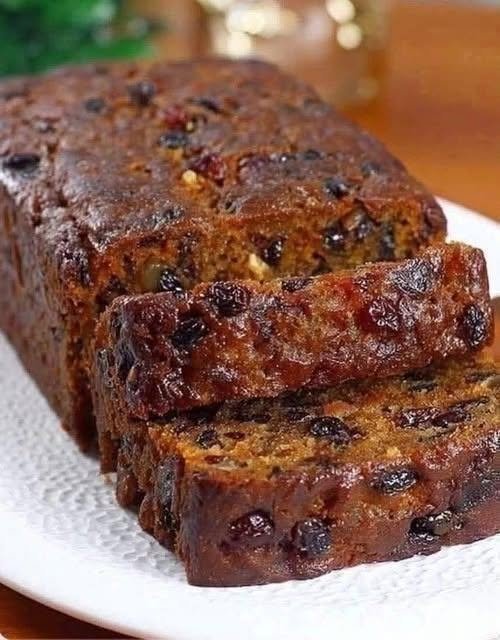
The cake in your photo looks like a rich, moist fruit cake/tea fruit loaf, packed with raisins and mixed dried fruit and baked until the outside becomes deeply caramelized while the center stays soft and dense.
This version is designed to produce a similar dark golden-brown crust, moist crumb, and generous fruit distribution.
Yield: 1 loaf (8 × 4 inch / 20 × 10 cm)
Slices: 10–12
Prep: 20 minutes
Soaking: 30 minutes to overnight
Baking: 50–65 minutes
Difficulty: Easy–moderate
Ingredients
Dried fruit
150 g raisins
75 g currants
75 g chopped dates
50 g chopped candied orange peel or mixed candied fruit
50 g dried cherries or additional raisins
120 ml orange juice or strong black tea
1 tsp vanilla extract
Optional: 1–2 tbsp rum or brandy for a traditional fruit-cake flavor.
For a completely alcohol-free cake, simply use orange juice or tea.
Cake batter
170 g all-purpose/plain flour
½ tsp baking powder
¼ tsp baking soda
½ tsp salt
1 tsp ground cinnamon
½ tsp ground nutmeg
¼ tsp ground cloves
¼ tsp ground ginger
115 g unsalted butter, softened
120 g brown sugar
50 g granulated sugar
2 large eggs, room temperature
80 g unsweetened applesauce
1 tsp vanilla extract
1 tbsp molasses or dark treacle, optional but excellent for a darker cake
60 ml milk
Optional nuts
For a traditional nutty version:
50 g chopped walnuts
50 g chopped almonds or pecans
The cake does NOT require nuts. If you want the cake to resemble the photograph closely, you can leave them out—the pictured cake appears predominantly fruit-filled.
Step-by-Step Method
1. Soak the dried fruit
Place the raisins, currants, dates, candied fruit and dried cherries in a bowl.
Pour over the warm orange juice or black tea.
Add vanilla and optional rum/brandy.
Mix and cover.
Quick method
Let stand for 30–45 minutes.
Better method
Soak for 4 hours or overnight in the refrigerator.
The longer soak makes the fruit plumper and gives the finished cake a much moister texture.
2. Prepare the oven and pan
Heat oven to:
165°C / 325°F
Grease an 8 × 4-inch loaf pan.
Line the bottom and long sides with parchment paper, leaving some paper hanging over the edges so you can lift the cake out.
Because fruit cake browns easily, lining the pan is particularly helpful.
3. Combine the dry ingredients
In a bowl, whisk together:
flour
baking powder
baking soda
salt
cinnamon
nutmeg
cloves
ginger
Set aside.
4. Cream the butter and sugar
Beat the softened butter, brown sugar and granulated sugar for about 3–4 minutes.
The mixture should become lighter and fluffy.
This step incorporates air into the batter and helps prevent an overly heavy cake.
5. Add the eggs
Add the eggs one at a time, beating well after each addition.
If the mixture looks slightly curdled, don’t worry—it will come together when the flour is added.
Mix in:
applesauce
vanilla
molasses/treacle
6. Add the flour
Add about half of the dry ingredients.
Mix gently.
Add the milk.
Then add the remaining dry ingredients.
Do not overmix.
Stop as soon as you no longer see dry flour.
7. Add the fruit
Drain the soaked fruit if there is significant excess liquid.
Reserve about 1–2 tablespoons of the soaking liquid.
Toss the fruit with 1 tablespoon of flour.
This helps reduce the fruit sinking to the bottom.
Fold the fruit gently into the batter.
If using nuts, fold them in now.
8. Fill the loaf pan
Transfer the batter to the prepared pan.
Smooth the top with a spatula.
Tap the pan gently on the counter once or twice to remove large air pockets.
For the appearance in your photograph, keep the batter fairly level rather than creating a high domed top.
9. Bake
Bake at 165°C / 325°F for approximately 50–65 minutes.
Start checking around 50 minutes.
The cake is done when:
the top is deeply golden brown
the center feels firm but slightly springy
a skewer inserted into the center comes out with a few moist crumbs
it does not contain wet batter
Important
If the top becomes dark before the center is cooked, loosely cover the loaf with aluminum foil and continue baking.
Fruit cakes can brown quickly because of their sugar and dried fruit.
10. Cool
Leave the cake in the pan for 15–20 minutes.
Lift it out using the parchment.
Place on a wire rack and allow it to cool completely.
Don’t slice it while hot.
The crumb is delicate when warm and becomes much better structured as it cools.
Optional: Make it extra moist and glossy
For the shiny appearance shown in the photograph, make a simple glaze.
Glaze
2 tbsp apricot jam
1 tbsp water
Warm together until smooth.
Brush the warm glaze over the cooled cake.
This gives the fruit cake a beautiful glossy, sticky surface.
Alternatively, brush the cake lightly with some of the reserved fruit-soaking liquid.
For an Even More Traditional Rich Fruit Cake
If you want a darker, richer cake rather than a light tea loaf, increase the following:
Brown sugar → 150 g
Molasses/treacle → 2 tbsp
Dried fruit → 400–450 g total
Orange juice → 150 ml
You can also replace 30 ml of the orange juice with rum or brandy.
After baking, wrap the completely cooled cake tightly in parchment and foil and let it rest 24–48 hours before serving.
The flavors become considerably deeper.
Nut Information & Allergens
The basic recipe
Contains:
Milk/dairy
Eggs
Wheat/gluten
Does not contain:
Peanuts
Tree nuts, provided you omit the optional walnuts/almonds/pecans
If using nuts
The best choices are:
walnuts
pecans
almonds
hazelnuts
Use approximately 100 g total.
Toast them lightly first, cool completely, then chop.
Important allergy note
If this is being prepared for someone with a serious nut allergy, check the labels of dried fruit, candied fruit, chocolate, flour and other packaged ingredients for allergen and cross-contact statements.
Also use clean utensils and equipment if avoiding cross-contact is important.
Gluten-Free Version
Replace the 170 g wheat flour with a 1:1 gluten-free baking flour blend containing xanthan gum.
Check that the baking powder, dried fruit and other packaged ingredients are certified gluten-free if required.
Dairy-Free Version
Replace:
Butter → plant-based baking butter or 90 ml neutral oil
Milk → oat, soy or another suitable plant milk
Eggs can remain.
Egg-Free Version
Use a suitable commercial egg replacer or approximately:
60 g applesauce per egg
Because this cake already contains applesauce, an egg-free version will be somewhat denser.
How to Get Beautiful Slices Like the Photo
The secret is cooling time.
For clean slices:
Cool completely.
Wrap and refrigerate for 1–2 hours, if desired.
Use a sharp serrated knife.
Cut with a gentle sawing motion.
Wipe the knife between slices.
Don’t press straight down—the dried fruit can pull at the crumb.
Frequently Asked Questions
Q: Why did my fruit sink to the bottom?
Usually the batter is too thin or the fruit is excessively wet.
Solution: drain the fruit well and toss it with a little flour before folding it into the batter.
Q: Why is my cake dry?
The most common causes are overbaking or measuring too much flour.
Use a kitchen scale if possible and start checking the cake at around 50 minutes.
Q: Why is my cake dense?
Fruit cake is naturally denser than a sponge cake, but it shouldn’t be gummy.
Possible causes include:
overmixing after adding flour
too much fruit
insufficient baking
old baking powder/baking soda
Q: Can I use only raisins?
Yes.
Use approximately 350–400 g raisins.
For better flavor, combine golden raisins and dark raisins.
Q: Can I use fresh fruit?
Not recommended.
Fresh fruit contains considerably more water and can make the loaf soggy.
Use dried fruit.
Q: Can I use black tea instead of orange juice?
Yes, and it’s an excellent option.
Strong black tea adds depth without making the cake taste strongly citrusy.
Q: Can I soak the fruit overnight?
Yes—this is actually my preferred method.
Keep it covered in the refrigerator, then bring the mixture toward room temperature before incorporating it.
Q: Can I make this without alcohol?
Absolutely.
Use orange juice, apple juice or strong black tea.
Orange juice gives the most naturally fruity flavor.
Q: How should I store the cake?
Once completely cool, wrap tightly.
At room temperature, it is generally best within 3–4 days.
Refrigeration can extend its storage life, but wrap it very well because refrigeration can dry cakes out.
Q: Can I freeze it?
Yes.
Wrap individual slices or the whole cake tightly in plastic wrap followed by foil.
Freeze for approximately 2–3 months for best quality.
Thaw while still wrapped so condensation forms on the wrapping rather than directly on the cake.
Q: Why does my fruit cake crack on top?
A moderate crack isn’t a problem. Fruit cake is relatively dense, so the outside can set before the center finishes expanding.
A slightly lower oven temperature and avoiding overfilling the pan can reduce cracking.
Q: Can I make muffins with this batter?
Yes. Divide into lined muffin cups and bake at approximately 175°C / 350°F for 20–25 minutes, checking with a skewer.
Q: What makes this cake especially moist?
The combination of soaked dried fruit + brown sugar + butter + applesauce + controlled baking time.
The soaked fruit gradually releases moisture into the crumb, which is why this cake is noticeably better the next day.
My recommended version for the pictured cake
For the closest result, use:
Raisins + currants + dates + candied orange peel + orange juice + brown sugar + butter + applesauce + cinnamon + nutmeg + a little molasses.
I’d skip the nuts if you want the appearance and texture of the pictured loaf: lots of small dark fruits throughout a moist, caramelized brown crumb.