
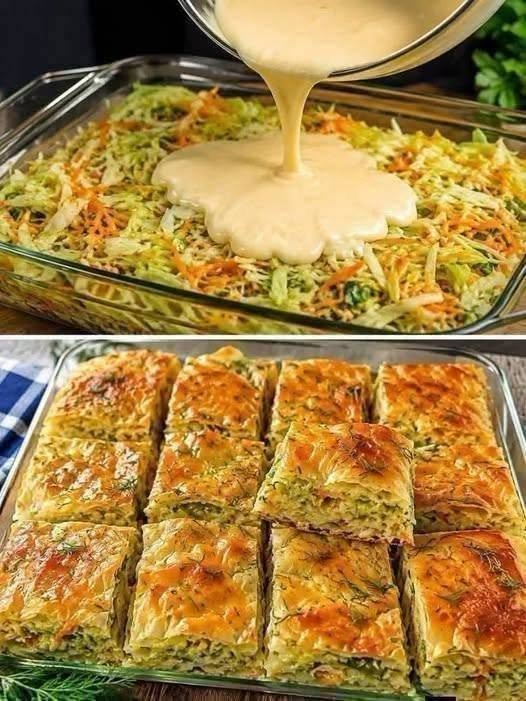
Yield: 12–16 pieces
Pan: 9 × 13 inch / 23 × 33 cm rectangular baking dish
Prep: 35–40 minutes
Cooking: 40–50 minutes
Total: about 1½ hours
Ingredients
For the cabbage filling
- 1 medium green/white cabbage — about 700–900 g
- 2 medium carrots
- 1 large onion
- 3–4 tbsp olive oil or vegetable oil
- 1 tsp salt, or to taste
- ½ tsp black pepper
- 1 tsp paprika
- ½ tsp red chili flakes — optional
- ½ tsp cumin — optional
- 2–3 tbsp chopped fresh dill
- 2–3 tbsp chopped fresh parsley
- 100–150 g feta cheese or crumbled white cheese — optional
- 2 eggs — optional, but useful for binding the filling
For the börek sauce
- 2 eggs
- 1 cup plain yogurt
- ½ cup milk
- ½ cup vegetable oil or melted butter
- 1 tbsp flour
- 1 tbsp vinegar
- ½ tsp salt
Optional:
½ tsp baking powder for a slightly lighter interior.
For the pastry
- 1 packet phyllo/yufka sheets, approximately 450–500 g
- 2–3 tbsp melted butter for brushing the top
- Sesame seeds — optional
- Nigella/black seeds — optional
- Dried or fresh dill — optional
Step 1 — Prepare the cabbage
Remove any damaged outer cabbage leaves.
Cut the cabbage into quarters and remove the hard central core.
Slice it very thinly, almost like making coleslaw.
You should have roughly 6–7 cups shredded cabbage.
Put the cabbage into a large bowl and add:
- ½–1 tsp salt
Massage the cabbage with your hands for 2–3 minutes.
This softens it and removes some excess water.
Let it sit for aboutCabbage contains a lot of water. If you put it raw 10 minutes.
Important
Cabbage contains a lot of water. If you put it raw and wet directly into the pastry, the börek can become soggy.
Step 2 — Prepare the vegetables
Grate the carrots.
Finely chop the onion.
Heat 3–4 tbsp oil in a large frying pan.
Add the onion and cook for approximately 3–4 minutes.
Add the grated carrots.
Cook another 3–4 minutes.
Now add the shredded cabbage.
Step 3 — Cook the filling
Cook the cabbage mixture over medium-high heat for approximately 8–12 minutes.
Stir frequently.
You want the cabbage to become noticeably softer and for some of its moisture to evaporate.
Add:
- black pepper
- paprika
- chili flakes, if using
- cumin, if using
Taste for salt.
Don’t completely cook it to mush.
The cabbage should be soft but still have a little texture because it will continue cooking inside the oven.
Remove from the heat.
Step 4 — Add herbs and cheese
Allow the filling to cool for about 10–15 minutes.
Then add:
- chopped dill
- chopped parsley
- crumbled feta/white cheese, if using
If you’re using the 2 eggs in the filling, beat them separately and mix them into the cooled cabbage.
Do not add eggs while the cabbage is extremely hot, or they’ll start cooking.
Mix everything well.
Step 5 — Make the börek sauce
In a bowl combine:
- 2 eggs
- 1 cup yogurt
- ½ cup milk
- ½ cup oil or melted butter
- 1 tbsp flour
- 1 tbsp vinegar
- ½ tsp salt
Whisk until completely smooth.
What does the vinegar do?
It helps create a tender, flaky pastry and can contribute to a crispier baked surface.
The sauce should be pourable, similar to a thin pancake batter.
If it’s extremely thick, add another 1–2 tbsp milk.
Step 6 — Assemble the börek
Preheat your oven to:
180°C / 350°F
Grease your baking dish.
Lay one sheet of phyllo in the bottom.
Don’t worry if it extends over the edges.
Brush or spoon some of the sauce over it.
Add another sheet.
Again, lightly coat it with sauce.
Continue with several sheets.
Step 7 — Add the cabbage filling
Spread approximately half of the cabbage mixture over the pastry.
Cover with another phyllo sheet.
Brush with sauce.
Add the remaining cabbage filling.
Spread it evenly.
Step 8 — Finish the layers
Cover the filling with the remaining phyllo sheets.
Brush each layer lightly with sauce.
Fold any overhanging pastry toward the center.
Brush the final sheet generously but evenly with the remaining sauce.
Finally brush the top with a little melted butter.
Sprinkle with:
- sesame seeds
- nigella seeds
if desired.
Step 9 — Cut BEFORE baking
This is important.
Use a sharp knife to cut the börek into:
- squares
- rectangles
- triangles
depending on the shape you want.
For the photo, rectangular pieces will give the closest appearance.
Cut all the way through the pastry layers, but don’t press down excessively.
Step 10 — carefully so Bake
Place the dish in the preheated oven.
Bake at:
180°C / 350°F for approximately 40–50 minutes
until the top becomes:
- deep golden brown
- crispy
- puffed
- visibly flaky
If the top browns too quickly, loosely cover it with aluminum foil for the remainder of the baking time.
Extra-crispy finish
For a particularly beautiful top like the photograph:
Increase the oven to 200°C / 400°F for the final 5–8 minutes.
Watch carefully so it doesn’t burn.
Step 11 — Rest before serving
Remove the börek from the oven.
Let it rest for 15–20 minutes before cutting again.
This is important because the filling will be extremely hot and soft immediately after baking.
Resting allows it to set.
How to serve it
Serve warm or at room temperature with:
- plain yogurt
- garlic yogurt
- cucumber yogurt
- tomato salad
- shepherd salad
- pickles
- Turkish-style tea
A simple garlic-yogurt sauce is particularly good.
Quick garlic yogurt
Mix:
- 1 cup thick yogurt
- 1 small garlic clove, finely grated
- pinch of salt
- 1 tbsp olive oil
That’s it.
Alternative: Rolled version
If you want pieces that look even more like the long rectangular pieces in your photograph, make individual rolls.
Take one phyllo sheet.
Brush with sauce.
Put cabbage filling along one edge.
Roll tightly into a long cylinder.
Place it into a greased baking tray.
Repeat with the remaining sheets.
Arrange the rolls next to each other.
Brush the entire surface with the remaining sauce.
Cut each roll into 2–3 pieces.
Bake at 180°C / 350°F for 40–45 minutes.
This method produces very defined rectangular pieces and lots of crispy edges.
Can I use raw cabbage?
Yes, but I don’t recommend it for this version.
Raw cabbage releases a lot of water while baking.
That can make the pastry:
- soggy
- heavy
- difficult to crisp
Briefly sautéing the cabbage first gives a much better result.
Q&A / Frequently Asked Questions
1. Can I make it without cheese?
Yes.
The cabbage itself provides plenty of flavor.
For a dairy-free filling, simply omit the cheese.
2. Can I use red cabbage?
You can, but green/white cabbage is preferable.
Red cabbage will produce a different color and slightly different flavor.
3. Can I add meat?
Absolutely.
For a meat version, brown approximately:
250–300 g ground beef
with the onion before adding the carrot and cabbage.
Make sure the meat is fully cooked before assembling the börek.
4. Can I add potatoes?
Yes.
Boil 1–2 medium potatoes, mash them roughly and mix them into the cooled cabbage.
This produces a softer, more substantial filling.
5. Why is my börek soggy?
Usually one of these reasons:
- The cabbage contained too much water.
- The filling was put into the pastry while very wet.
- Too much sauce was used.
- The oven wasn’t hot enough.
- The börek wasn’t baked long enough.
- The finished börek was covered while still hot.
Best solution: cook the cabbage until most of its moisture evaporates and bake until deeply golden.
6. Why did my phyllo tear?
Phyllo dries extremely quickly.
Keep unused sheets covered with a slightly damp kitchen towel while working.
Don’t make the towel soaking wet, or the pastry can become sticky.
7. Can I use frozen phyllo?
Yes.
Thaw it overnight in the refrigerator.
Then let it sit at room temperature for approximately 30–60 minutes before using.
Don’t try to separate completely frozen sheets.
8. Can I use puff pastry?
You can, but the result will be completely different.
Puff pastry produces a thicker, buttery, breadier pastry.
For the appearance in your photograph, phyllo/yufka is the better choice.
9. Can I prepare it the night before?
Yes.
You have two good options.
Option A — Best: prepare the filling the day before and refrigerate it. Assemble and bake the next day.
Option B: assemble the entire börek, cover and refrigerate overnight, then bake the following day.
Don’t leave an uncooked egg-containing mixture at room temperature.
10. Can I freeze it?
Yes.
For best results, freeze it after baking.
Let it cool completely, cut into portions and wrap well.
Freeze for up to approximately 2–3 months for best quality.
Reheat directly from frozen at about:
180°C / 350°F for 15–25 minutes
until hot and crisp.
An air fryer also works very well.
11. Can I make it vegetarian?
Yes—the basic recipe is vegetarian.
Use cheese if you like, or omit it.
12. Can I make it vegan?
Yes, with substitutions.
Use:
- vegan phyllo
- plant-based yogurt
- plant milk
- olive oil instead of butter
- egg substitute or simply omit eggs from the sauce
The texture will be slightly different but still delicious.
Tips for the BEST result
Tip 1 — Don’t leave the cabbage watery
This is the single most important point.
Tip 2 — Cool the filling
Hot filling + phyllo = softened pastry.
Tip 3 — Don’t drown the phyllo
Every layer needs some sauce, but it shouldn’t be swimming in liquid.
Tip 4 — Use enough fat
Oil/butter is what gives börek its characteristic flaky, crisp texture.
Tip 5 — Bake until genuinely golden
Don’t remove it when it’s merely pale yellow.
The deeper golden color means better flavor and crunch.
Tip 6 — Rest it
Give it 15–20 minutes after baking.
Tip 7 — Use fresh herbs
Dill is especially good with cabbage.
Easy measurement version
If you don’t have a scale, use:
Filling
- 1 medium cabbage
- 2 carrots
- 1 onion
- 4 tbsp oil
- 1 tsp salt
- ½ tsp pepper
- 1 tsp paprika
- handful dill
- handful parsley
- ½–1 cup crumbled cheese
Sauce
- 2 eggs
- 1 cup yogurt
- ½ cup milk
- ½ cup oil
- 1 tbsp flour
- 1 tbsp vinegar
Pastry
- 1 packet phyllo/yufka
Bake 180°C / 350°F for 40–50 minutes.
.