
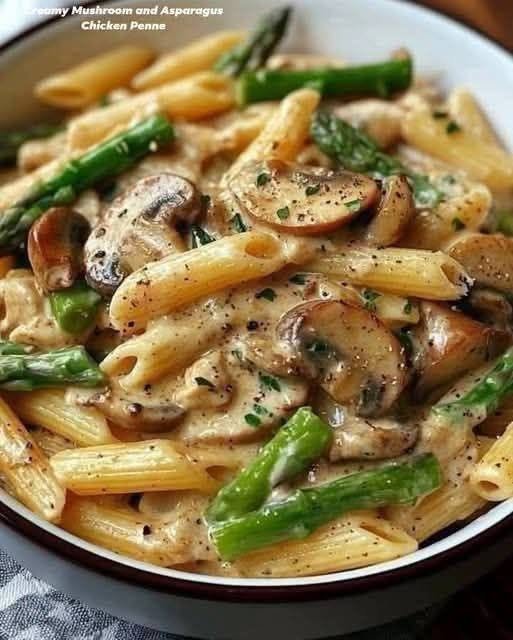
The photo looks like a creamy chicken penne with mushrooms, asparagus, garlic, herbs, and Parmesan. Here’s a close homemade version, with substitutions and nutrition/allergen notes.
Ingredients — 4 servings
Pasta & chicken
340 g (12 oz) penne pasta
450 g (1 lb) boneless, skinless chicken breast, bite-size pieces
1 tbsp olive oil
1 tsp Italian seasoning
½ tsp black pepper
¾ tsp salt
Vegetables
225–250 g mushrooms, sliced
250 g asparagus, cut into 3–4 cm pieces
3 garlic cloves, minced
1 tbsp butter
Cream sauce
1 cup (240 ml) heavy cream
½ cup (120 ml) chicken broth
½ cup (45–50 g) finely grated Parmesan
½ tsp Italian seasoning
¼ tsp black pepper
¼ tsp salt, or to taste
1 tbsp chopped fresh parsley
Optional: ¼ tsp chili flakes
Optional: 1 tsp lemon juice
Method
Cook the pasta.
Boil well-salted water and cook penne until just al dente. Reserve about ½ cup pasta water, then drain.
Cook the chicken.
Season chicken with salt, pepper and Italian seasoning. Heat olive oil in a large skillet over medium-high heat. Cook for about 5–7 minutes, turning occasionally, until browned and cooked through. Remove to a plate.
Sauté the vegetables.
Add butter to the same skillet. Add mushrooms and cook 4–5 minutes until browned. Add asparagus and cook another 3–4 minutes. Add garlic during the final minute.
Make the sauce.
Lower heat to medium. Add chicken broth and scrape up the browned bits from the pan. Add cream, Italian seasoning and pepper. Simmer gently for 3–5 minutes—don’t aggressively boil it.
Add Parmesan.
Reduce the heat to low and gradually stir in Parmesan until melted and creamy.
Combine.
Return chicken to the skillet. Add drained penne and toss everything together. If the sauce is too thick, add reserved pasta water 1 tablespoon at a time.
Finish.
Stir in parsley and, if desired, a small squeeze of lemon juice. Taste and adjust salt and pepper.
Serve immediately with extra Parmesan and black pepper.
For the closest appearance to your photo
Use large sliced mushrooms, fairly thick asparagus pieces, penne cooked al dente, plenty of cracked black pepper, parsley, and a relatively thick cream sauce. Don’t overcook the asparagus—you want it bright green rather than olive-colored.
Nut information
The basic recipe contains no tree nuts or peanuts. However:
Parmesan itself isn’t a tree nut.
Check the labels of chicken broth, Parmesan, cream, pasta and seasonings if cooking for someone with a serious allergy because packaged products can have cross-contact warnings.
For a completely nut-free meal, use products specifically labeled according to the allergy requirements you need.
Do not substitute almond/cashew cream if the dish needs to remain nut-free.
For dairy-free, use a dairy-free cream alternative and dairy-free Parmesan-style product—but check those products carefully for nuts.
Approximate nutrition
The exact numbers depend heavily on the cream, Parmesan, pasta and amount of oil used. Chicken breast itself is particularly protein-dense: USDA-derived data puts cooked roasted chicken breast at about 165 kcal and 31 g protein per 100 g.
F
FoodData Central
+1
Asparagus is comparatively light, at roughly 20 kcal, 2.2 g protein and 2.1 g fiber per 100 g.
W
What You Eat
For this recipe, a reasonable estimate is approximately:
Per serving Approx.
Calories 700–800 kcal
Protein 45–55 g
Carbohydrates 65–75 g
Fat 30–40 g
Fiber 5–7 g
These are estimates, not laboratory measurements; changing cream, Parmesan, pasta or oil can substantially change the result.
Q&A
Q: Can I use milk instead of heavy cream?
Yes. Use whole milk for a lighter sauce, but it will be thinner. You can add 1–2 tsp cornstarch mixed with cold water if necessary.
Q: Can I use chicken thighs?
Absolutely. Boneless, skinless thighs will give you a richer, juicier dish.
Q: Can I make it without chicken?
Yes. Increase the mushrooms and asparagus, or add spinach, peas or another vegetable for a vegetarian version. Use vegetable broth.
Q: Can I use penne pasta alternatives?
Yes—rigatoni, fusilli, farfalle or spaghetti work. Gluten-free penne also works if needed.
Q: How do I stop the cream sauce from separating?
Keep the heat moderate and avoid a hard boil after adding the cream and Parmesan. Add Parmesan over low heat.
Q: Why is my sauce too thick?
Add reserved pasta water gradually. The starch helps loosen the sauce while keeping it creamy.
Q: Can I prepare it ahead?
Yes, but creamy pasta is best fresh. Refrigerate leftovers promptly in a covered container and reheat gently with a splash of milk or broth.
Q: Can I freeze it?
You can, but cream sauces may become slightly grainy after freezing and reheating. For best texture, freeze the chicken/vegetable component separately and make the sauce fresh.
Q: How do I make it lower calorie?
Use half-and-half instead of heavy cream, reduce Parmesan slightly, use less butter/oil, and increase the asparagus and mushrooms.
Q: How do I make it extra creamy like the picture?
Use heavy cream, freshly grated Parmesan, and a little reserved pasta water. Toss the pasta directly in the sauce rather than simply spooning sauce over it.
For food-safety purposes, cook the chicken thoroughly; USDA FoodData Central identifies cooked chicken breast as a distinct food preparation, and nutritional values vary with the cooking method.