
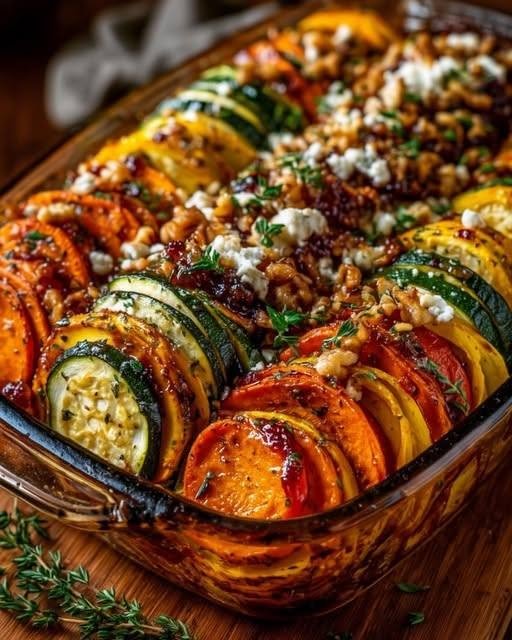
The dish in your photo looks like a Mediterranean-style roasted vegetable casserole made with overlapping slices of zucchini, yellow squash, tomatoes and sweet potato, finished with crumbled feta, toasted nuts, herbs and a sweet-savory glaze.
The exact original recipe can’t be determined from the photograph alone, so the recipe below is a close, practical recreation designed to produce the same appearance and flavor.
Serves
6–8
Prep
25 minutes
Roast
45–60 minutes
Total
About 1 hour 15 minutes
Ingredients
Vegetables
2 medium zucchini
2 medium yellow squash
2 medium sweet potatoes
3–4 medium Roma tomatoes
1 large red onion
4 cloves garlic
3 tbsp extra-virgin olive oil
1 tsp salt
½ tsp freshly ground black pepper
1 tsp dried oregano
1 tsp dried thyme
½ tsp smoked paprika
Nut topping
¾ cup walnuts, pecans, or almonds, roughly chopped
1 tsp olive oil
Pinch of salt
½ tsp smoked paprika
1 tsp honey or maple syrup, optional
Feta topping
100–150 g feta cheese, crumbled
2 tbsp fresh parsley, chopped
1 tbsp fresh thyme leaves
1 tbsp fresh rosemary, finely chopped, optional
Balsamic-honey glaze
3 tbsp balsamic vinegar
1½ tbsp honey or maple syrup
1 tbsp olive oil
1 tsp Dijon mustard
1 small garlic clove, finely grated
Pinch of black pepper
1. Prepare the vegetables
Preheat the oven to 200°C / 400°F.
Wash and dry the zucchini, yellow squash and tomatoes.
Slice the vegetables into approximately 5–7 mm rounds.
Peel the sweet potatoes and slice them into similarly thin rounds.
Slice the red onion into thin wedges.
Important
Try to keep the vegetable slices roughly the same thickness. This allows everything to roast at approximately the same rate and gives you the attractive repeating pattern seen in the photograph.
2. Make the seasoning oil
In a small bowl combine:
3 tbsp olive oil
salt
black pepper
oregano
thyme
smoked paprika
minced garlic
Whisk together.
Put the sliced vegetables into a large bowl and gently toss with the seasoned oil.
Don’t completely drown them in oil—the vegetables will release moisture as they roast.
3. Arrange the casserole
Lightly oil a large baking dish, approximately 23 × 33 cm / 9 × 13 inches.
Arrange the vegetables vertically and tightly, alternating colors:
zucchini → tomato → yellow squash → sweet potato → zucchini → tomato…
Continue until the dish is full.
This alternating arrangement is what creates the striped appearance in the photograph.
If some slices are larger than others, tuck the smaller pieces toward the center.
Scatter the red onion between the rows.
4. First roast
Cover the dish loosely with aluminum foil.
Bake at 200°C / 400°F for approximately 25 minutes.
Remove the foil.
Continue roasting for another 20–30 minutes.
The vegetables should be:
tender in the center
caramelized around the edges
slightly browned on top
still visually distinct rather than completely collapsed
If the vegetables aren’t browning enough, increase the oven to 220°C / 425°F for the final 5–8 minutes.
5. Prepare the nut topping
While the vegetables roast, roughly chop the walnuts or pecans.
Heat 1 tsp olive oil in a small skillet over medium-low heat.
Add the nuts, salt and smoked paprika.
Toast for 3–5 minutes, stirring frequently.
If desired, add 1 tsp honey or maple syrup during the final minute and toss quickly.
Remove from the heat immediately.
Don’t over-toast them
Nuts can go from golden to burnt very quickly. They should smell nutty and look lightly browned.
6. Make the glaze
Combine:
balsamic vinegar
honey/maple syrup
olive oil
Dijon mustard
grated garlic
black pepper
Whisk vigorously.
For a thicker glaze, place the mixture in a small saucepan and simmer gently for 3–5 minutes.
Allow it to cool slightly.
7. Finish the vegetable bake
When the vegetables are fully roasted, remove the dish from the oven.
Scatter over:
crumbled feta
toasted nuts
fresh parsley
fresh thyme
Drizzle the balsamic-honey glaze over the top.
For the appearance in the photograph, don’t completely cover the vegetables. Drizzle the glaze in thin lines so the individual colors remain visible.
Return the dish to the oven for 3–5 minutes, just enough to warm the feta.
Alternatively, leave the feta completely fresh and serve immediately after adding it.
Finishing garnish
Add a final scattering of:
fresh thyme
parsley
freshly cracked black pepper
A very small drizzle of good extra-virgin olive oil also works beautifully.
Serve directly in the baking dish.
For the exact visual style
To get closer to the photograph:
Use red tomatoes, orange sweet potatoes, green zucchini and yellow squash.
Slice everything thinly and consistently.
Arrange the slices upright and tightly packed.
Roast uncovered for the final half of cooking.
Use walnuts or pecans for the chunky topping.
Add feta only near the end.
Finish with dark balsamic glaze and bright green herbs.
The contrast between the colorful vegetables, white feta, brown nuts and green herbs is a major part of the presentation.
Nut information
The pictured-style recipe contains nuts
The proposed topping uses walnuts or pecans.
You can substitute:
almonds
pistachios
hazelnuts
pumpkin seeds
sunflower seeds
Nut-free version
Simply omit the nuts or replace them with toasted pumpkin seeds (pepitas) or sunflower seeds.
The vegetables, feta and glaze themselves don’t require nuts.
Allergy note
If preparing this for someone with a nut allergy, check packaged ingredients such as feta, mustard, spice blends and balsamic glaze for allergen statements and cross-contact warnings.
Other allergen information
Contains
Dairy: feta
Nuts: if walnuts/pecans/almonds are used
Mustard: Dijon mustard
Potential sulfites: some commercial vinegars/glazes may contain them
Naturally free from
The basic vegetable dish is naturally:
egg-free
meat-free
fish-free
shellfish-free
soy-free
For a completely dairy-free version, omit the feta or use a suitable dairy-free alternative.
Useful substitutions
Original Substitute
Zucchini Eggplant
Yellow squash Bell pepper
Sweet potato Butternut squash
Roma tomato Cherry tomatoes
Feta Goat cheese
Walnuts Pecans/pistachios
Honey Maple syrup
Balsamic vinegar Red-wine vinegar + a little honey
Thyme Rosemary or oregano
Eggplant variation
If using eggplant, salt the slices lightly and leave them for about 15–20 minutes, then pat dry. This helps remove some surface moisture before roasting.
What to serve with it
This casserole works particularly well alongside:
grilled chicken
roasted lamb
baked fish squash contain a lot of water. Overcrowding, very thick slices and insufficient oven heat can increase
chickpeas
couscous
quinoa
crusty sourdough
a simple green salad
For a vegetarian main course, serve it with warm crusty bread and a chickpea or lentil salad.
Q&A
Can I prepare this ahead of time?
Yes. Assemble the vegetables several hours ahead and refrigerate, covered. Let the dish sit out for about 20–30 minutes before roasting.
For the best texture, add the nuts, feta and fresh herbs after roasting rather than several hours beforehand.
Why are my vegetables watery?
Tomatoes, zucchini and squash contain a lot of water. Overcrowding, very thick slices and insufficient oven heat can increase the problem.
Roast uncovered toward the end and avoid adding extra liquid to the baking dish.
Should I peel the zucchini and squash?
No. Their colorful skins contribute to the appearance and help the slices retain their shape.
Do I need to peel the tomatoes?
No.
Can I use regular potatoes?
Yes, although they generally need a little longer cooking than zucchini and tomatoes. Slice them thinly.
Can I use only one type of squash?
Absolutely. Use all zucchini, all yellow squash, or a combination.
Can I make it vegan?
Yes. Replace the feta with a plant-based feta or simply omit it.
Use maple syrup rather than honey for the glaze.
Can I make it gluten-free?
Yes. The recipe as written is naturally gluten-free provided your packaged ingredients are certified/labelled appropriately for your needs.
Can I make it without balsamic vinegar?
Yes. Use a little lemon juice plus honey/maple syrup, or simply finish with olive oil and herbs.
Why add the nuts at the end?
Roasting them separately keeps them crisp and intensely nutty. If they’re buried among the wet vegetables for an hour, they’ll become soft.
Can I use pre-made balsamic glaze?
Yes. Drizzle approximately 1–2 tablespoons over the finished casserole instead of making the glaze.
How do I know when it’s done?
Insert a thin knife into the thickest sweet-potato slice. It should pass through easily. The zucchini and squash should be tender, with browned edges.
How long do leftovers keep?
Refrigerate leftovers promptly in a covered container and use within 3–4 days. Reheat in an oven or air fryer when possible; microwaving tends to make the vegetables softer.
Can I freeze it?
You can, but the zucchini and tomatoes will become considerably softer after thawing. For the best texture, freeze the roasted vegetables without the feta, nuts and fresh herbs, then add those after reheating.
Flavor profile
The finished dish has four main contrasts:
Sweet: roasted sweet potato + tomato + honey
Savory: garlic + herbs + feta
Acidic: balsamic vinegar
Crunchy: toasted walnuts/pecans
That combination is what gives this type of vegetable bake its sweet, tangy, creamy and crunchy character.