
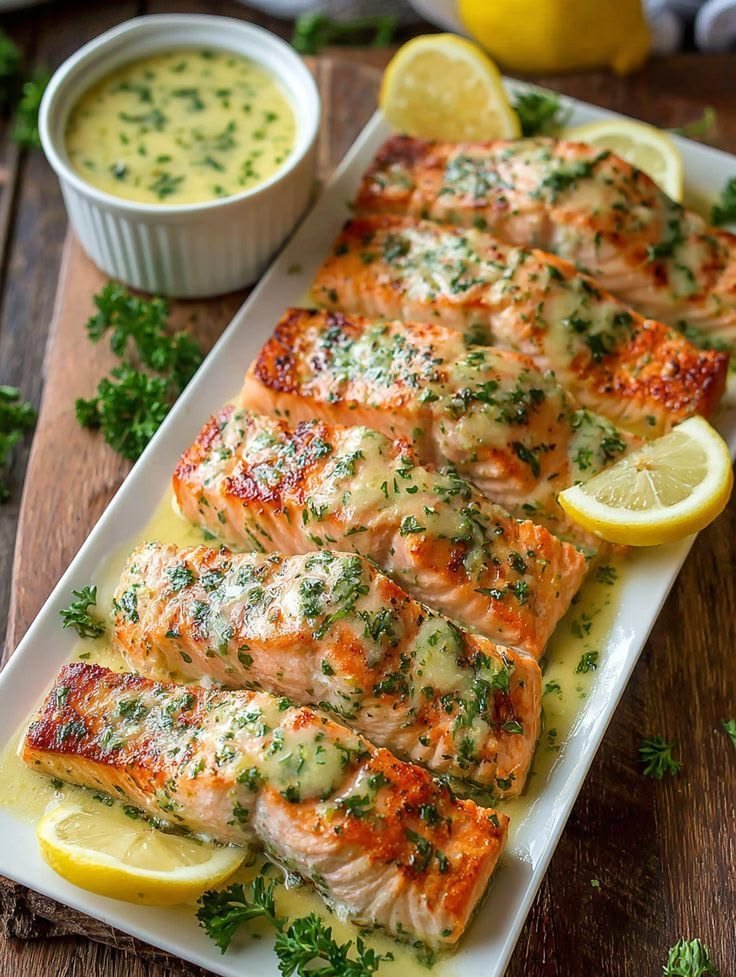
The photo appears to show individual salmon fillets seared or roasted until golden, then coated with a lemon-garlic herb butter sauce, with fresh parsley and lemon wedges. This recipe is designed to produce that glossy, buttery appearance and browned surface.
Food-safety note: For a fully cooked salmon, the USDA/FDA benchmark is 145°F (63°C) in the thickest part. Cooking time varies substantially with fillet thickness, so temperature is more reliable than the clock.
1
101 Cooking For Two
+1
Recipe at a glance
Servings: 4
Prep: 10–15 minutes
Cook: 12–18 minutes
Total: about 30 minutes
Style: Lemon garlic butter / herb salmon
Difficulty: Easy
Ingredients
For the salmon
4 salmon fillets, about 150–180 g (5–6 oz) each
1 tbsp olive oil
¾ tsp salt
½ tsp freshly ground black pepper
½ tsp paprika — optional, for the golden-red color
½ tsp garlic powder — optional
Lemon-garlic herb butter
4 tbsp unsalted butter, softened or melted
3–4 garlic cloves, finely minced
1 tbsp fresh lemon juice
1 tsp finely grated lemon zest
2 tbsp fresh parsley, finely chopped
1 tbsp fresh dill, finely chopped — optional
¼ tsp black pepper
Small pinch of salt
¼ tsp chili flakes — optional
For serving
1 lemon, cut into wedges or slices
Extra parsley
A little additional melted herb butter, if desired
Garlic, lemon, butter and fresh herbs are a common combination for baked salmon, and recipes from university extension programs also use lemon, herbs, garlic and olive oil with salmon.
F
Fox and Briar
+1
Detailed cooking method
1. Prepare the salmon
Remove the salmon from its packaging and pat it very dry with paper towels.
This is important because excess moisture encourages steaming rather than browning.
If the fillets have skin, leave it on.
2. Make the herb butter
In a small bowl combine:
softened butter
minced garlic
lemon zest
lemon juice
parsley
dill
black pepper
chili flakes, if using
Mix thoroughly.
For an appearance close to the photograph, use softened butter rather than completely liquid butter. It stays on top of the fish better before cooking.
3. Season the fish
Brush the salmon lightly with olive oil.
Sprinkle with salt, black pepper and paprika.
Don’t heavily salt the fish because the butter will also contain seasoning.
Option 1 — Oven method
This is the easiest way to reproduce the appearance in the photograph.
4. Preheat
Heat the oven to:
400°F / 200°C
Line a baking tray with parchment paper or foil.
5. Add the butter
Place the salmon on the tray, skin-side down if it has skin.
Spread the lemon-garlic butter generously over each fillet.
Put a few lemon slices around the salmon.
6. Bake
Bake for approximately 12–15 minutes, depending on thickness.
Start checking early rather than relying exclusively on the cooking time.
The fish should become opaque and separate into flakes when gently tested. For fully cooked salmon, check the thickest section with an instant-read thermometer and cook to 145°F / 63°C.
1
101 Cooking For Two
+1
Very thick pieces can take longer.
7. Rest
Remove the salmon and let it rest for about 2–3 minutes.
Spoon the melted lemon-garlic butter from the tray back over the salmon.
Finish with fresh parsley and lemon juice.
Option 2 — Pan-seared method
This gives you more browning and is particularly good if you want the deeply golden surface visible in the picture.
1. Heat the pan
Heat a large heavy skillet over medium-high heat.
Add 1 tbsp olive oil.
2. Sear
Place the salmon skin-side down if applicable.
Cook approximately 4–5 minutes without moving it, allowing the surface to develop a crust.
3. Turn
Carefully turn the salmon and cook another 2–3 minutes.
4. Add butter
Reduce the heat to medium-low.
Add:
3–4 tbsp butter
garlic
As the butter melts, spoon it repeatedly over the salmon.
This creates the glossy coating seen in the photograph.
5. Add lemon
Turn the heat low and add lemon juice.
Don’t add a large quantity of lemon juice while the pan is extremely hot, because the sauce can separate rapidly.
6. Check doneness
Use a thermometer in the thickest portion. For fully cooked fish, the target is 145°F / 63°C.
1
101 Cooking For Two
+1
How to make the sauce extra creamy
For a richer sauce similar to the one shown:
Remove cooked salmon from the pan.
Lower heat to very low.
Add 2 tbsp butter.
Add 1–2 tbsp lemon juice.
Add 1–2 tbsp water or chicken/fish stock.
Whisk continuously.
Add parsley.
Return the salmon briefly to the pan.
Spoon sauce over the top.
For an actual cream sauce, add ¼ cup heavy cream after the garlic has cooked, simmer gently for 1–2 minutes, then add lemon juice at the end.
Flavor variations
Mediterranean
Add:
oregano
dill
parsley
extra lemon
1 tbsp olive oil
Spicy garlic
Add:
½ tsp chili flakes
¼ tsp cayenne
extra garlic
Honey lemon
Add 1–2 tsp honey to the butter sauce. This creates a slightly sweet, caramelized glaze.
Creamy garlic
Add ¼ cup heavy cream to the pan sauce.
Dairy-free
Replace butter with olive oil or a suitable plant-based butter. Garlic-butter salmon recipes commonly use olive oil as the dairy-free alternative.
T
Textual Chef
Nut information & allergens
This recipe naturally contains:
Fish: salmon
Milk: butter
Potential allergen: depending on the brand, prepared seasonings or plant-based butter may contain additional allergens.
It does not normally contain
Peanuts
Tree nuts
Wheat
Gluten
Eggs
Soy
However, check packaged ingredients and allergen statements if you’re cooking for someone with a severe allergy.
Can I add nuts?
Yes, but nuts aren’t necessary.
Good additions include:
chopped almonds
pistachios
walnuts
pine nuts
For example, sprinkle 2 tbsp toasted chopped pistachios over the finished salmon.
If serving someone with a nut allergy, keep the recipe nut-free and avoid cross-contact from cutting boards, utensils and packaged ingredients.
Approximate nutrition
For one 6-oz salmon fillet with a portion of the butter sauce, a reasonable estimate is approximately:
Nutrient Approx. per serving
Calories 350–450 kcal
Protein 30–35 g
Fat 23–32 g
Carbohydrates 1–4 g
Fiber <1 g
Sugar <2 g
The exact numbers depend heavily on the salmon’s size and how much butter is actually consumed. Published salmon recipes show similar ranges, but nutrition calculations are estimates.
F
Fox and Briar
+1
What to serve with it
For a complete dinner:
Low-carb
cucumber-tomato salad
steamed broccoli
asparagus
sautéed spinach
With carbohydrates
roasted potatoes
mashed potatoes
rice
garlic bread
couscous
South Asian-style
basmati rice
cucumber raita
lemon-coriander salad
roasted vegetables
The lemon-butter sauce is especially good spooned over rice or potatoes.
Recipe Q&A
Can I use frozen salmon?
Yes. Thaw it completely in the refrigerator before cooking and pat it dry. Frozen salmon can release considerably more moisture during cooking.
Can I use salmon with the skin?
Absolutely. Cook it skin-side down. The skin helps protect the fish and can become crispy.
Why is my salmon dry?
Usually because it has been cooked too long. Salmon thickness varies considerably, so start checking the thickest portion early rather than following a fixed cooking time.
Why is white stuff coming out of my salmon?
That’s usually albumin, a protein that can appear on the surface as salmon cooks. It isn’t automatically a sign that the fish has gone bad. Avoiding excessive cooking can reduce its appearance.
Can I use dried parsley?
Yes, but fresh parsley gives the bright green appearance shown in the photograph. Use about 1 tsp dried parsley in place of 1 tbsp fresh.
Can I use bottled lemon juice?
You can, but fresh lemon gives a noticeably fresher flavor and provides zest for the sauce.
Can I make the butter sauce ahead?
Yes. Make the garlic-herb butter several hours ahead and refrigerate it. Bring it toward room temperature before spreading it over the salmon.
Can I marinate the salmon overnight?
I wouldn’t use a strongly acidic lemon marinade overnight. Lemon can alter the texture of the fish. For this recipe, coat it shortly before cooking.
How do I get the salmon as brown as in the picture?
Pat it very dry, use moderately high heat, avoid overcrowding the pan, and don’t constantly move the fish. A short pan sear followed by gentle oven finishing gives particularly good browning.
Can I cook the salmon in an air fryer?
Yes. A practical starting point is 400°F / 200°C for roughly 7–10 minutes, depending on thickness. Check the center rather than relying solely on time.
How should leftovers be stored?
Refrigerate leftovers promptly in a covered container and reheat gently so the salmon doesn’t dry out.
Can I make this without butter?
Yes. Use olive oil with garlic, lemon and herbs. You’ll get a lighter sauce rather than the rich buttery coating shown in the photograph.
U
University of Maryland Extension
For the closest match to the photo
Use thick 5–6 oz salmon portions, pat them extremely dry, season with salt/pepper/paprika, pan-sear until deeply golden, then finish with butter + garlic + lemon + parsley. Spoon the bubbling herb butter over the salmon repeatedly and finish with fresh parsley and lemon wedges. That combination produces the browned exterior, glossy sauce and fresh green garnish visible in the image.