
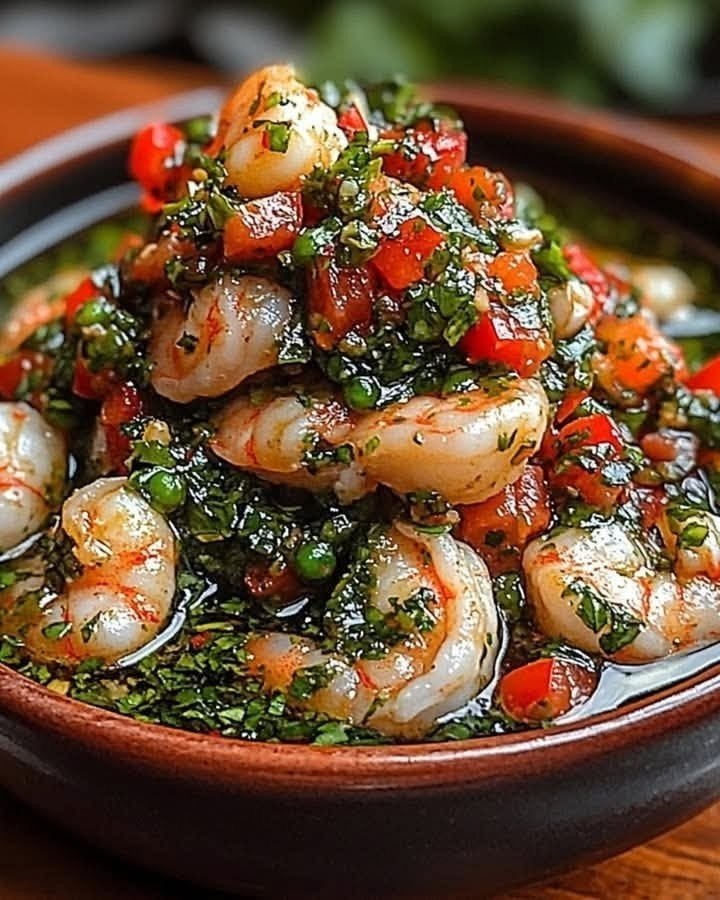
The dish in your photo looks like juicy shrimp coated in a bright, oily chimichurri-style herb sauce, with chopped tomato/red pepper, green herbs, garlic, chili, and plenty of olive oil. It has a rustic, colorful appearance and can be served as an appetizer, main course, or over rice/bread.
The recipe below is designed to recreate that glossy, heavily herb-coated look and flavor.
Yield: 4 servings
Prep: 20 minutes
Cook: 8–10 minutes
Total: about 30 minutes
Difficulty: Easy–moderate
Ingredients
For the shrimp
500 g (1.1 lb) large shrimp/prawns, peeled and deveined
1 tsp salt
½ tsp black pepper
1 tsp smoked paprika
½ tsp sweet paprika
½ tsp ground cumin
¼ tsp red chili flakes
2 tbsp olive oil
4 cloves garlic, finely minced
1 tbsp lemon juice
For the chimichurri
½ cup finely chopped fresh parsley
¼ cup finely chopped fresh cilantro/coriander
2–3 tbsp finely chopped fresh mint
3 cloves garlic, very finely minced
½ small red chili, finely chopped
½ tsp red chili flakes
½ tsp dried oregano
½ tsp salt
¼ tsp black pepper
2 tbsp red-wine vinegar
1½ tbsp fresh lemon juice
⅓ cup extra-virgin olive oil
For the vegetables shown in the picture
1 medium tomato, finely diced
½ red bell pepper, finely diced
¼ green bell pepper or 1 small green chili, finely diced
2 tbsp finely chopped onion or shallot
1 tbsp chopped cilantro
1 tbsp chopped parsley
Optional finishing ingredients
1 tbsp pomegranate seeds
Extra lemon wedges
Fresh chili slices
A drizzle of extra-virgin olive oil
A pinch of flaky salt
A little grated lemon zest
1. Prepare the shrimp
If using frozen shrimp, thaw them in the refrigerator overnight. For faster thawing, keep them sealed in a bag and place them in cold water; seafood should not simply be left on the counter to thaw.
U
U.S. Food and Drug Administration
+1
Remove the shells if necessary and devein the shrimp.
Pat them extremely dry with paper towels.
This is important because wet shrimp will steam rather than develop the beautiful golden edges seen in the photograph.
Put the shrimp into a bowl and add:
salt
black pepper
smoked paprika
sweet paprika
cumin
chili flakes
1 tbsp olive oil
Toss thoroughly.
Don’t add the lemon juice yet. Acid can start changing the texture of the shrimp if it sits too long.
2. Make the chimichurri
Finely chop the parsley, cilantro, mint, chili and garlic.
For the best texture, hand-chop rather than pulverizing everything in a blender. You want tiny pieces of herbs suspended in olive oil rather than a completely smooth green paste.
Combine:
parsley + cilantro + mint + garlic + chili + oregano + salt + black pepper
Add:
red-wine vinegar
lemon juice
olive oil
Mix well.
Taste it.
You are looking for a combination of:
herbaceous + garlicky + acidic + salty + slightly spicy + fruity from the olive oil.
If it tastes flat, add a little more salt.
If it tastes too oily, add another teaspoon of vinegar or lemon juice.
If it tastes too acidic, add another tablespoon of olive oil.
Set aside for at least 10 minutes before serving. This allows the garlic and herbs to flavor the oil.
3. Prepare the colorful vegetable topping
Finely dice:
tomato
red pepper
green pepper/chili
onion
Mix them with a tablespoon each of chopped parsley and cilantro.
Add a tiny pinch of salt.
Don’t add too much salt at this stage because the shrimp and chimichurri are already seasoned.
For an appearance closer to the photograph, keep the vegetable pieces small—around 5 mm dice.
4. Cook the shrimp
Heat a large skillet over medium-high to high heat.
Add 1 tablespoon olive oil.
When the pan is hot, arrange the shrimp in a single layer.
Don’t overcrowd the pan.
Cook for approximately:
1½–2½ minutes on the first side
Then turn them.
Cook another:
1–2 minutes
Add the minced garlic during the final minute.
Add 1 tablespoon lemon juice and toss.
Shrimp should become firm and opaque/pearly. Food-safety guidance recommends cooking seafood to a safe temperature; shrimp should be pearly/opaque, and seafood guidance commonly specifies 145°F/63°C when using a thermometer.
U
U.S. Food and Drug Administration
+1
Important
Don’t keep cooking shrimp simply because you’re worried about them being underdone.
Overcooked shrimp become:
rubbery
dry
tough
difficult to coat nicely with the sauce
As soon as they’re properly cooked, remove the pan from the heat.
5. Add the chimichurri
This is the trick that gives you the appearance in the photograph.
Remove the skillet from direct heat.
Add approximately ½ of the chimichurri to the hot shrimp.
Toss gently.
The residual heat will release the aroma of the herbs and garlic without aggressively frying all the fresh herbs.
Then add:
diced tomato
red pepper
green pepper
onion
Toss again.
Finally, spoon the remaining chimichurri over the top.
This creates the fresh green-and-red appearance rather than turning the entire dish into a cooked green sauce.
6. Plate it like the photograph
Use a shallow ceramic bowl.
Start with a small pool of chimichurri.
Arrange the shrimp in a mound.
Spoon the chopped tomato and peppers between the shrimp.
Add extra chopped parsley and cilantro.
Drizzle with olive oil.
Finish with:
lemon zest
chili slices
flaky salt
lemon wedges
For an especially dramatic presentation, put one or two larger shrimp on top.
How to Make It Look Even More Like the Image
The photograph has a particularly lush, almost salsa-like chimichurri.
For that style, increase the following:
Parsley → ¾ cup
Cilantro → ⅓ cup
Tomato → 1½ tomatoes
Red pepper → ¾ pepper
Olive oil → up to ½ cup
Garlic → 5–6 cloves
Chili → 1 whole small red chili
The result will be wetter, greener and more heavily coated.
Nut Information & Allergens
Good news: traditional chimichurri is normally nut-free.
This recipe contains no peanuts or tree nuts.
There are also no:
almonds
walnuts
cashews
pistachios
hazelnuts
pecans
macadamia nuts
However, if you’re preparing this for someone with a serious nut allergy, check the labels on packaged spices, chili products and other ingredients and prevent cross-contact with cutting boards, knives, pans and oils.
Optional nuts?
You can add toasted pine nuts, almonds or pistachios for crunch, but I would not add them if you’re trying to reproduce the pictured dish.
If serving someone with a nut allergy, simply leave them out.
Can I Make It Without Cilantro?
Absolutely.
Some people find cilantro unpleasant because of genetic differences in how they perceive certain flavor compounds.
Replace the cilantro with:
additional parsley
basil
mint
a combination of parsley and basil
A particularly good combination is:
½ cup parsley + ¼ cup basil + 2 tbsp mint.
Oven Version
You can also roast the shrimp.
Heat oven to 220°C / 425°F.
Spread seasoned shrimp on a lightly oiled baking tray.
Roast for approximately 6–9 minutes, depending on shrimp size.
Remove immediately when cooked.
Toss with the fresh chimichurri afterward.
This is particularly useful when cooking a large batch.
Grill Version
For a smoky version:
Pat shrimp dry.
Season with paprika, cumin, salt, pepper and olive oil.
Thread onto skewers.
Grill over high heat.
Cook roughly 2 minutes per side, depending on size.
Remove.
Brush generously with chimichurri.
Finish with lemon.
Tip: If using wooden skewers, soak them first so they don’t burn.
What to Serve With It
Best options
1. Garlic rice
Probably the easiest complete meal.
2. Crusty bread
Excellent because the bread absorbs the herb-and-garlic oil.
3. Couscous
The fluffy grains work particularly well with the acidic sauce.
4. Roasted potatoes
Especially good with smoked paprika in the shrimp.
5. Grilled vegetables
Try:
zucchini
eggplant
bell peppers
asparagus
corn
6. Salad
A simple cucumber, tomato and lettuce salad keeps the meal fresh.
7. Pasta
Toss the shrimp and chimichurri with spaghetti or linguine.
🥑 Creamy Variation
For a richer version, make a quick avocado sauce:
1 ripe avocado
2 tbsp Greek yogurt
1 tbsp lemon juice
1 small garlic clove
pinch of salt
1–2 tbsp water
Blend until smooth.
Put the avocado cream underneath the shrimp and spoon the chimichurri over the top.
Spicy Version
For serious heat, add:
1 finely chopped jalapeño
½ tsp cayenne
1 red chili
extra chili flakes
For a smoky-hot version, use chipotle powder instead of some of the paprika.
Extra-Garlicky Version
Use:
6 cloves garlic in the chimichurri
3 cloves during cooking
But don’t burn the garlic.
Burned garlic becomes bitter and can overwhelm the fresh herbs.
Can I Prepare It Ahead?
Yes.
Chimichurri
Make it several hours ahead and refrigerate.
Take it out about 15–20 minutes before serving so the olive oil can loosen up.
Chopped vegetables
Can be prepared several hours ahead.
Keep refrigerated.
Shrimp
Season shortly before cooking rather than leaving raw shrimp sitting in lemon juice for hours.
Cooked shrimp
Refrigerate leftovers promptly. Perishable food shouldn’t remain at room temperature for more than 2 hours, or 1 hour when the ambient temperature is above 90°F/32°C.
F
Food Safety and Inspection Service
+1
Storage
Put leftovers into a shallow airtight container and refrigerate.
For best quality, eat within 3–4 days.
Keep the chimichurri separate if possible; the herbs retain a fresher flavor that way.
When reheating shrimp, heat gently rather than aggressively frying them again.
Approximate Nutrition
For 1 of 4 servings, assuming the full amount of olive oil is consumed:
Nutrient Approx. amount
Calories 350–420 kcal
Protein 30–35 g
Fat 22–28 g
Carbohydrates 7–10 g
Fiber 2–3 g
Sugar 3–4 g
Sodium Highly dependent on salt
Cholesterol Relatively high
These are approximate because shrimp size, oil quantity and serving size can change the numbers considerably.
Want it lighter?
Reduce the olive oil in the chimichurri from ⅓ cup to ¼ cup and serve with vegetables rather than bread or rice.
Want it more filling?
Serve it over:
brown rice
quinoa
couscous
potatoes
whole-grain bread
Recipe Q&A
Q: Can I use frozen shrimp?
Yes. Frozen shrimp can be excellent. Thaw them safely, drain and pat them very dry before cooking.
U
U.S. Food and Drug Administration
Q: Do I have to devein shrimp?
It’s recommended for appearance and texture, although the vein is the digestive tract rather than a conventional “vein.”
Q: Why did my shrimp become rubbery?
Usually because they were cooked too long.
Shrimp cook very quickly. Once they’re opaque and firm, get them off the heat.
Q: Why isn’t my shrimp browned?
Most likely the shrimp were wet or the pan wasn’t hot enough.
Dry shrimp + hot pan + enough space produces much better browning.
Q: Can I marinate the shrimp in chimichurri?
Yes, but I prefer using oil, garlic and spices for the initial seasoning and adding most of the fresh chimichurri after cooking.
That keeps the herbs bright and fresh.
Q: Can I use bottled lemon juice?
You can, but fresh lemon juice tastes considerably better in this recipe.
Q: Can I use dried parsley?
Not for the main chimichurri.
Fresh herbs are a major part of the character of this dish.
Q: Can I omit vinegar?
Yes.
Increase the lemon juice slightly, although vinegar gives chimichurri its characteristic sharpness.
Q: Can I use cilantro instead of parsley?
You can, but that changes the flavor substantially. A mixture of parsley and cilantro gives the most balanced result.
Q: Is this the same as traditional Argentine chimichurri?
Not exactly. Traditional chimichurri varies considerably, but the photographed dish appears to be a more elaborate, salsa-like shrimp preparation incorporating chimichurri-style herbs, peppers and tomato.
Q: Is this keto-friendly?
The basic shrimp and chimichurri are generally compatible with a low-carbohydrate diet. Avoid serving it with rice, bread or potatoes if you need to keep carbohydrates very low.
Q: Is this gluten-free?
The ingredients listed here are naturally gluten-free, but packaged spices and other processed ingredients should be checked for cross-contact if you have celiac disease or significant gluten sensitivity.
Q: Is this dairy-free?
Yes. The main recipe contains no dairy.
Q: Is this egg-free?
Yes.
Q: Is this nut-free?
Yes, as written. Don’t add optional pine nuts or other nuts, and take cross-contact precautions for anyone with a severe allergy.
Q: Can I use scallops instead?
Yes. Scallops work beautifully with the same chimichurri. They require different cooking timing and should be cooked until opaque and firm.
U
U.S. Food and Drug Administration
Q: Can I use chicken?
Yes, but chicken requires substantially different cooking treatment. Don’t use shrimp cooking times for chicken.
Q: Can I use this recipe for a party?
Definitely. Cook the shrimp in batches and arrange them on a large platter.
Keep the chimichurri separate until shortly before serving.
Q: What’s the secret to the restaurant-style flavor?
Three things:
Cooked shrimp
Refrigerate leftovers promptly. Perishable food shouldn’t remain at room temperature for more than 2 hours, or 1 hour when the ambient temperature is above 90°F/32°C.
F
Food Safety and Inspection Service
+1
Storage
Put leftovers into a shallow airtight container and refrigerate.
Keep the chimichurri separate if possible; the herbs retain a fresher flavor that way.
Approximate Nutrition
Nutrient Approx. amount
Calories 350–420 kcal
Protein 30–35 g
Fat 22–28 g
Carbohydrates 7–10 g
Fiber 2–3 g
Sugar 3–4 g
Sodium Highly dependent on salt
Cholesterol Relatively high
These are approximate because shrimp size, oil quantity and serving size can change the numbers considerably.
Want it lighter?
Reduce the olive oil in the chimichurri from ⅓ cup to ¼ cup and serve with vegetables rather than bread or rice.
Want it more filling?
Serve it over:
brown rice
quinoa
couscous
potatoes
whole-grain bread
Recipe Q&A
Dry the shrimp extremely well.
Use high heat for quick browning.
Add fresh chimichurri after cooking rather than cooking all of it.
That combination gives you juicy shrimp plus fresh garlic, herbs, acidity and olive oil.
My Recommended Version
If you’re specifically trying to reproduce the dish in your photo, I’d use:
500 g large shrimp + ¾ cup parsley + ⅓ cup cilantro + 2 tbsp mint + 5 garlic cloves + 1 red chili + 1½ tomatoes + ½ red bell pepper + ⅓ cup olive oil + 2 tbsp red-wine vinegar + lemon + smoked paprika + cumin.
Cook the shrimp very quickly over high heat, then fold in half the chimichurri and the diced vegetables, and finish with the other half spooned generously over the top.
That will give you the juicy shrimp, vivid red-and-green colors, glossy olive-oil finish, garlicky aroma and chunky herb texture characteristic of the pictured dish.
Food-safety note: seafood should be cooked safely; USDA/FDA guidance emphasizes using a thermometer where appropriate and notes that shrimp should become firm, pearly/opaque.