
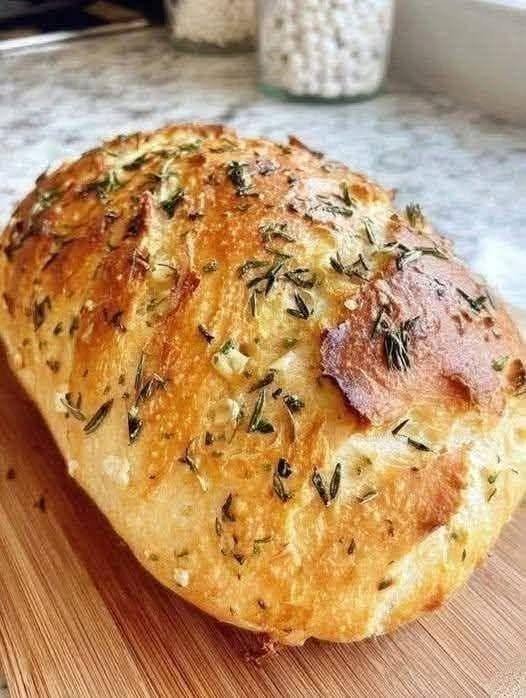
The loaf in your photo looks like a crusty, rustic no-knead garlic-and-herb bread: golden blistered crust, soft chewy center, and plenty of rosemary/thyme and garlic on the surface. A Dutch oven is ideal because the covered pot traps steam and helps produce that crackly crust. Similar no-knead versions use a long rise followed by a hot Dutch-oven bake.
K
Kitchn
+1
Makes
1 large loaf — about 10–12 slices
Time
Active preparation: 15–20 minutes
First rise: 8–12 hours
Shaping/proof: 1–1½ hours
Baking: 45–50 minutes
Cooling: at least 30 minutes
Total: roughly 10–14 hours, mostly unattended
Ingredients
For the dough
Ingredient Amount
All-purpose or bread flour 3 cups / 375 g
Warm water 1½ cups / 360 ml
Instant yeast 1 tsp
Salt 1½ tsp / 8–9 g
Olive oil 1 tbsp / 15 ml
Honey or sugar 1 tsp optional
Fresh garlic, finely minced 3–4 cloves
Fresh rosemary, finely chopped 1–1½ tbsp
Fresh thyme leaves 1–1½ tbsp
Black pepper ¼ tsp, optional
For the top
1 tbsp olive oil
1 tsp chopped rosemary
1 tsp thyme leaves
1 small garlic clove, very finely minced
Pinch of flaky sea salt
Optional: a little melted butter after baking
Fresh rosemary, thyme and garlic are commonly used together in this style of rustic no-knead loaf.
K
Kitchn
+1
Step-by-step recipe
1. Activate the yeast
If using active dry yeast, mix it with the warm water and honey/sugar.
Let it stand for 5–10 minutes.
You should see some foam.
If you’re using instant yeast, you can simply mix it directly with the flour.
Water should be warm, not hot—roughly 38–43°C / 100–110°F.
2. Mix the dry ingredients
In a large bowl combine:
Step-by-step recipe
1. Activate the yeast
375 g flour
1½ tsp salt more intensely garlic-herb-flavored-nut-free exact numbers depend heavily on the flour, salt and amount of oil. For comparison, a published garlic-herb no-knead recipe calculates about 143 kcal, 25.7 g carbohydrate, 3.7 g protein and 2.6 g fat per serving. Dutch oven
rosemary
thyme
black pepper
minced garlic
Mix well.
3. Add the liquids
Pour in:
360 ml warm water
1 tbsp olive oil
yeast mixture, if using active dry yeast
Mix with a wooden spoon or spatula.
You want a sticky, shaggy dough.
Don’t knead it.
There should be no large pockets of dry flour, but the dough should look considerably wetter and rougher than conventional bread dough.
4. First rise
Cover the bowl tightly with plastic wrap, a lid, or a damp kitchen towel.
Leave at room temperature for:
8–12 hours
Overnight is perfect.
The dough should become:
noticeably larger
bubbly
soft
stretchy
somewhat wobbly
A long fermentation develops flavor without requiring traditional kneading. Similar garlic-herb no-knead recipes use roughly 6–8 hours for the initial rise.
K
Kitchn
5. Shape the loaf
Lightly flour your work surface.
Turn the dough out.
Don’t aggressively punch all the air out.
Sprinkle the dough with a little flour and gently fold the edges toward the center several times.
Turn it over so the seams are underneath.
Using your hands, gently form it into a round boule.
6. Second rise
Place the dough on parchment paper.
Cover loosely.
Let it rise for approximately:
60–90 minutes
It should become puffy but doesn’t necessarily need to double.
7. Preheat the Dutch oven
About 30–45 minutes before baking, place your Dutch oven—with its lid—inside the oven.
Heat to:
230°C / 450°F
The extremely hot pot is important for the crust.
8. Prepare the topping
Mix:
1 tbsp olive oil
1 tsp rosemary
1 tsp thyme
1 finely minced garlic clove
When the dough is ready, brush or drizzle the mixture over the top.
Sprinkle with a little flaky salt.
You can also make 2–3 shallow cuts across the top with a sharp knife or bread lame. This gives the loaf room to expand.
🫕 9. Bake
Carefully remove the extremely hot Dutch oven.
Transfer the dough into it using the parchment as a sling.
Covered:
Bake at 230°C / 450°F for 30 minutes.
Uncovered:
Remove the lid and continue baking for:
12–18 minutes
until deeply golden brown.
A comparable roasted-garlic herb loaf uses 30 minutes covered followed by about 15 minutes uncovered, with an internal temperature around 210°F / 99°C as a useful bread-doneness check.
K
Kitchn
Target appearance
You want:
deep golden-brown crust
darker brown edges
visible herbs
crisp/crackly exterior
hollow-ish sound when tapped
10. Cool before cutting
Remove the bread from the pot and place it on a wire rack.
Do not immediately slice it.
Allow it to cool for at least 30 minutes, preferably 45–60 minutes.
This allows the interior crumb to finish setting.
Optional garlic-butter finish
For a richer loaf similar to the one pictured, combine:
2 tbsp softened butter
1 small garlic clove, grated
½ tsp rosemary
½ tsp thyme
tiny pinch of salt
noticeably larger
bubbly
soft
stretchy
somewhat wobbly
5. Shape the loaf
Brush this over the hot crust immediately after baking.
This gives you a softer, more intensely garlic-herb-flavored crust.
Nut information / allergen information
Does this recipe contain nuts?
No.
The basic recipe contains no peanuts or tree nuts.
It is also naturally:
6. Second rise
Place the dough on parchment paper.
Let it rise for approximately:
About 30–45 minutes before baking, place your Dutch oven—with its lid—inside the oven.
230°C / 450°F
8. Prepare the topping
Mix:
Sprinkle with a little flaky salt.
You can also make 2–3 shallow cuts across the top with a sharp knife or bread lame. This gives the loaf room to expand.
🫕 9. Bake
Carefully remove the extremely hot Dutch oven.
Uncovered:
Remove the lid and continue baking for:
12–18 minutes
A comparable roasted-garlic herb loaf uses 30 minutes covered followed by about 15 minutes uncovered, with an internal temperature around 210°F / 99°C as a useful bread-doneness check.
Target appearance
You want:
deep golden-brown crust
darker brown edges
visible herbs
crisp/crackly exterior
hollow-ish sound when tapped
Vegetarian
Egg-free
Soy-free
Dairy-free unless butter is added
Peanut-free
Tree-nut-free
A comparable roasted garlic and herb no-knead bread is likewise listed as peanut-free, tree-nut-free, dairy-free, egg-free and vegan when made with olive oil.
K
Kitchn
Important cross-contamination note
If you’re making this for someone with a serious nut allergy, check the labels on:
Optional garlic-butter finish
For a richer loaf similar to the one pictured, combine:
2 tbsp softened butter
1 small garlic clove, grated
½ tsp rosemary
½ tsp thyme
tiny pinch of salt
This gives you a softer, more intensely garlic-herb-flavored crust.
Nut information / allergen information
Does this recipe contain nuts?
No.
The basic recipe contains no peanuts or tree nuts.
It is also naturally:
Vegetarian
Egg-free
Soy-free
Dairy-free unless butter is added
Peanut-free
Tree-nut-free
Important cross-contamination note
flour
packaged herbs
butter
flavored oils
toppings
and use clean equipment that hasn’t contacted nuts.
Approximate nutrition
For the basic loaf without butter, divided into 12 slices, a reasonable estimate is:
Nutrient Approx. per slice
Calories 140–155 kcal
Carbohydrates 25–28 g
Protein 4 g
Fat 2–3 g
Saturated fat <1 g
Fiber 1–2 g
Sodium 250–350 mg
The exact numbers depend heavily on the flour, salt and amount of oil. For comparison, a published garlic-herb no-knead recipe calculates about 143 kcal, 25.7 g carbohydrate, 3.7 g protein and 2.6 g fat per serving.
K
Kitchn
Adding garlic butter will substantially increase the calories and fat.
Recipe Q&A
Q: Can I use dried rosemary and thyme?
Yes.
Use approximately:
1 tsp dried rosemary
1 tsp dried thyme
Fresh herbs give a more fragrant result, but dried herbs work well.
Q: Can I use bread flour?
Absolutely.
Bread flour: chewier, more elastic crumb.
All-purpose flour: slightly softer, more tender loaf.
For the loaf pictured, I’d use bread flour or a 50:50 bread-flour/all-purpose mixture.
Q: My dough is extremely sticky. Is that normal?
Yes.
This is a high-hydration no-knead dough. Don’t keep adding flour until it becomes a conventional firm dough.
Use lightly floured or oiled hands when shaping.
Q: My dough didn’t rise overnight.
Possible causes include:
Yeast is old/inactive.
Water was too hot or too cold.
Room temperature was very low.
Too much salt came directly into contact with the yeast.
The dough simply needs more time.
Nutrient Approx. per slice
Calories 140–155 kcal
Carbohydrates 25–28 g
Protein 4 g
Fat 2–3 g
Saturated fat <1 g
Fiber 1–2 g
Sodium 250–350 mg
Recipe Q&A
Q: Can I use dried rosemary and thyme?
Yes.
Use approximately:
Move it somewhere comfortably warm and give it another 1–2 hours.
Q: Can I make it without a Dutch oven?
Yes.
Place the shaped loaf on a baking sheet or pizza stone.
Put a separate sturdy pan on a lower oven rack and pour hot water into that pan when the bread goes in. The steam helps approximate the environment created by a covered Dutch oven.
Q: Why is my crust not as crispy as the picture?
Usually one of these:
oven wasn’t hot enough
Dutch oven wasn’t preheated
too little steam
bread was covered too long
bread was stored while still warm
Bake uncovered for several extra minutes if necessary.
Q: Why did my garlic burn?
Fresh minced garlic on the outside can burn at 230°C/450°F.
For a more evenly roasted garlic flavor, roast the garlic first and fold the softened cloves into the dough. This is a technique specifically used in roasted-garlic no-knead bread.
K
Kitchn
For the prettiest loaf, I’d use roasted garlic inside + a small amount of fresh garlic in the topping.
Q: Can I add cheese?
Yes. Try:
Q: My dough is extremely sticky. Is that normal?
Yes.
Q: My dough didn’t rise overnight.
Possible causes include:
Yeast is old/inactive.
Water was too hot or too cold.
Room temperature was very low.
Too much salt came directly into contact with the yeast.
The dough simply needs more time.
Move it somewhere comfortably warm and give it another 1–2 hours.
Q: Can I make it without a Dutch oven?
Q: Why is my crust not as crispy as the picture?
Usually one of these:
oven wasn’t hot enough
Dutch oven wasn’t preheated
too little steam
bread was covered too long
bread was stored while still warm
Q: Why did my garlic burn?
Parmesan
cheddar
mozzarella
Gruyère
Add roughly ½–1 cup grated cheese during shaping.
Cheese will make the loaf richer and may brown faster.
Q: Can I add olives?
Yes. Add about ½ cup chopped, well-drained olives during the shaping stage.
Kalamata olives + rosemary + garlic work particularly well.
Q: Can I add nuts?
You can, although the photographed loaf appears to be nut-free.
Good additions would be:
chopped walnuts
pistachios
almonds
Use approximately ½ cup chopped nuts and fold them in during shaping.
If you’re serving someone with a nut allergy, don’t add them and take cross-contact precautions.
Q: How should I store it?
For the best crust, keep the cooled loaf at room temperature for the first day.
Once cut, place it cut-side down on a board or wrap it.
For longer storage, slice and freeze it in portions. Reheat/toast individual slices directly from frozen.
If you add perishable fillings or toppings, storage requirements change; USDA recommends refrigerating perishable leftovers promptly rather than leaving them at room temperature for extended periods.
F
Food Safety and Inspection Service
+1
Q: Can I prepare the dough in the morning and bake at night?
Yes.
Use a shorter first rise of about 2–4 hours, depending on room temperature and yeast quantity, then shape and proof before baking.
For the deepest flavor, however, the overnight fermentation is preferable.
For a loaf closest to your photograph
I’d make this exact combination:
375 g bread flour + 360 g water + 1 tsp yeast + 8 g salt + 1 tbsp olive oil + 1 tsp honey + 4 garlic cloves + 1½ tbsp rosemary + 1½ tbsp thyme.
Then:
8–12 hr rise → shape → 75 min proof → 450°F/230°C covered 30 min → uncovered 15 min → cool 45 min.
That should give you the golden, rustic, herb-speckled crust and soft chewy center shown in your photo.