
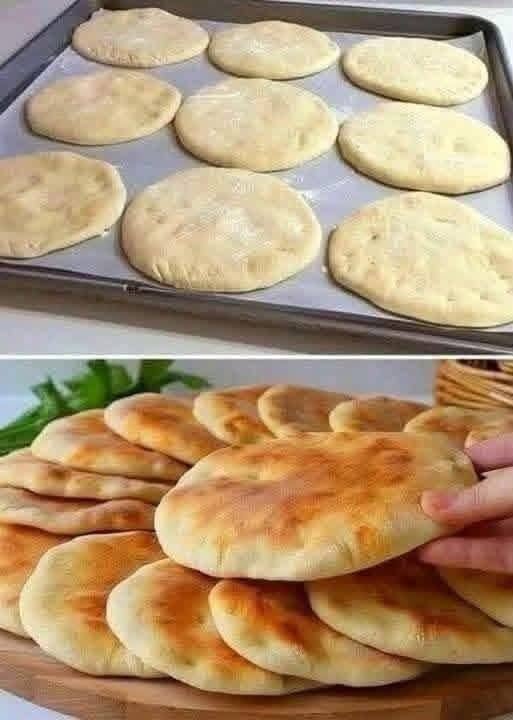
Yield: 8–10 breads
Prep: 20 minutes
Rest: 30–60 minutes
Cooking: 15–20 minutes
Total: about 1–1½ hours
Ingredients
3 cups (375 g) all-purpose flour
½ cup (120 g) plain yogurt
¾ cup (180 ml) lukewarm water, approximately
1½ tsp salt
1 tsp sugar
1 tsp baking powder
½ tsp baking soda
2 tbsp olive oil
Extra flour for rolling
A little oil or butter for cooking
The yogurt + baking-powder/baking-soda approach is a useful way to get a soft, fluffy, yeast-free flatbread.
R
Real Greek Recipes
Method
1. Make the dough
Put the flour, salt, sugar, baking powder and baking soda in a large bowl.
Mix well.
Add the yogurt and olive oil.
Gradually add the lukewarm water while mixing.
Bring everything together into a soft dough.
Important: Don’t add all the water immediately. Flour and yogurt vary, so you may need slightly less or more.
2. Knead
Transfer the dough to a lightly floured surface.
Knead for 6–8 minutes, until it becomes smooth and elastic.
The finished dough should be soft and slightly tacky, but it shouldn’t stick heavily to your hands.
3. Rest
Put the dough into a lightly oiled bowl and cover it.
Rest for 30–60 minutes.
This makes the dough considerably easier to roll and helps produce a softer bread.
4. Divide
Divide into 8–10 equal balls.
For the size shown in your picture, I’d use 8 pieces.
Roll each piece into a smooth ball and cover them with a clean towel.
Let them rest another 10 minutes.
5. Roll
Lightly flour your work surface.
Roll each ball into a round approximately:
6–7 inches / 15–18 cm wide
About 3–5 mm thick
Don’t make the edges extremely thin. The relatively thick dough helps produce the soft, pillowy appearance seen in your photo.
6. Cook
Heat a heavy skillet/tawa over medium-high heat.
It should be properly hot before the first bread goes in.
Place one flatbread on the dry pan.
Cook approximately:
First side: 60–90 seconds
Second side: 45–75 seconds
You should see bubbles developing and brown spots appearing.
Flip again briefly if necessary.
For the appearance in your photograph, aim for golden-brown patches rather than dark, crisp spots.
7. Keep them soft
As each bread comes off the pan, stack it underneath a clean kitchen towel.
Covering the hot breads traps some steam and keeps them soft. Similar towel-covering is also recommended for oven-baked pita.
G
Good Food Middle East
+1
Brush lightly with butter or olive oil if desired.
For the exact look in your picture
Use these adjustments:
8 dough balls rather than 10
Roll them fairly thick
Don’t over-flour while rolling
Use a very hot heavy tawa/skillet
Cook quickly rather than slowly
Don’t press the bread down constantly
Stack immediately under a towel
For extra softness, brush each finished bread with butter + a tiny amount of water, then cover
If you want pockets, use a thinner, more evenly rolled dough and very high heat. Traditional pita puffs because moisture in the dough turns to steam, separating the layers.
B
Budget Bytes
Optional garlic-butter topping
Mix:
2 tbsp melted butter
1 small garlic clove, finely grated
1 tbsp chopped coriander/parsley
Pinch of salt
Brush over the hot breads.
For a Pakistani/Indian-style variation, add a little kalonji (nigella), sesame, or dried coriander before cooking.
Approximate nutrition
For 1 of 8 breads, using the recipe above and before optional butter topping:
Nutrient Approx. per bread
Calories 190–220 kcal
Carbohydrates 30–34 g
Protein 5–6 g
Fat 5–7 g
Fiber 1–2 g
Sugar 1–2 g
Sodium ~300–400 mg
These are estimates; exact values change with the flour, yogurt, oil and amount of salt. Published pita recipes show similar ranges—for example, one whole-wheat version reports 151 kcal and 5 g protein per bread, while another reports 193 kcal and 6 g protein.
D
Dassana’s Veg Recipes
+1
Allergens / “nut info”
Contains:
Wheat/gluten
Milk/dairy, if regular yogurt is used
Does not inherently contain:
Peanuts
Tree nuts
Egg
Soy
The recipe can be made dairy-free by using unsweetened plant yogurt or replacing the yogurt with additional water, although the texture will change. Pita itself can be naturally dairy-free and vegan depending on the recipe.
W
Whole Foods Market
+1
Recipe Q&A
Why didn’t my bread puff?
Usually one of these:
Dough was rolled too thin or unevenly.
Pan wasn’t hot enough.
Dough wasn’t rested sufficiently.
Too much flour was incorporated.
The surface dried out while the dough was resting.
For pocket-style pita, even thickness and very high heat are particularly important.
G
Good Food Middle East
+1
Why is my flatbread hard?
It was probably cooked too long. Remove it when you have golden/brown spots but the bread is still flexible.
Can I make it without yogurt?
Yes. Replace the ½ cup yogurt with roughly ¼–⅓ cup additional water, adding it gradually. The yogurt version will generally be softer.
Can I use whole-wheat flour?
Yes. Start by replacing 25–50% of the white flour with whole-wheat flour. Using 100% whole wheat generally produces a denser bread and may require additional water.
Can I make the dough ahead?
Yes. Keep the covered dough refrigerated and bring it toward room temperature before shaping. Cooked flatbreads can also be refrigerated or frozen; reheating briefly in a hot pan helps restore softness.
D
Dassana’s Veg Recipes
Can I cook these in the oven?
Yes. For true pocket pita, oven baking at very high temperature is particularly effective. One tested approach uses an oven around 250°C/480°F or higher with a thoroughly heated tray.
G
Good Food Middle East
How do I store them?
Cool completely, then place in an airtight bag/container. Refrigerate for several days or freeze for longer storage. Separate frozen breads with parchment if you want to remove them individually.
How do I make them extra soft?
The biggest factors are a soft dough, adequate resting, short cooking time, and covering the breads immediately after cooking.
What can I serve with them?
They’re excellent with:
Chicken or beef shawarma
Seekh kebab
Chicken tikka
Hummus
Baba ganoush
Chana
Daal
Scrambled eggs
Grilled vegetables
Garlic butter
Tip: If your goal is to reproduce the exact breads shown in the photograph, I’d use the 8-piece, thick, yogurt-based skillet version above rather than a thin pocket-pita recipe.