
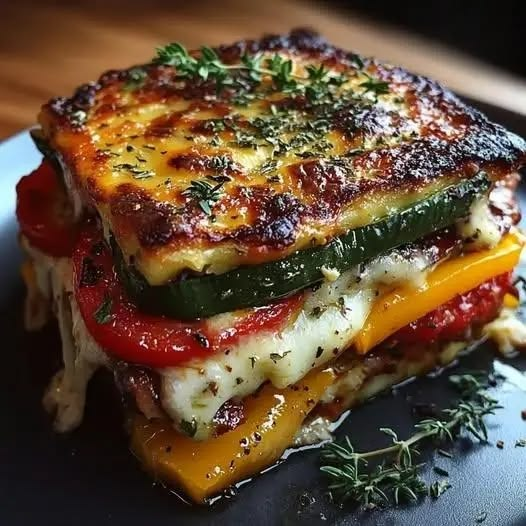
The photo looks like a loaded grilled vegetable cheese sandwich/panini: crisp, deeply browned bread on the outside, layers of zucchini, red and yellow peppers, tomato, stretchy mozzarella, herbs, and a buttery/garlicky finish.
This version is designed to reproduce that tall, cheesy, caramelized appearance while keeping the vegetables flavorful rather than watery. Similar grilled-vegetable sandwiches commonly combine zucchini, peppers, mozzarella, basil/herbs and balsamic or olive oil, with the sandwich pressed until the cheese melts.
N
NutriFood Index
+2
Servings
Makes: 2 large sandwiches
Prep: 20 minutes
Cooking: 20–25 minutes
Total: about 45 minutes
Difficulty: Medium
Ingredients
For the vegetables
1 medium zucchini, cut lengthwise into 5–6 mm slices
1 small red bell pepper, sliced into wide strips
1 small yellow/orange bell pepper, sliced
1 medium tomato, sliced fairly thin
½ small red onion, thinly sliced — optional
1½ tbsp extra-virgin olive oil
½ tsp salt
¼ tsp black pepper
½ tsp dried oregano
½ tsp dried Italian herbs
½ tsp paprika
1 small garlic clove, finely minced
For the sandwich
4 thick slices sourdough, ciabatta, focaccia, or sturdy Italian bread
150–180 g mozzarella, preferably low-moisture mozzarella
2 tbsp butter, softened
1 small garlic clove, grated
1 tbsp chopped fresh parsley
1 tsp chopped fresh thyme
½ tsp dried oregano
1–2 tsp grated Parmesan — optional
Fresh basil or thyme for finishing
Optional finishing sauce
Mix:
1 tbsp balsamic vinegar
1 tsp honey
1 tsp olive oil
Pinch of black pepper
Or simply use a little balsamic glaze.
Step-by-Step Method
1. Prepare the zucchini
Slice the zucchini lengthwise rather than into very thin rounds.
Sprinkle very lightly with salt and leave for 5–10 minutes.
Pat dry with paper towels.
Why? Zucchini contains a lot of water. Removing some surface moisture helps it brown instead of steaming inside the sandwich.
2. Make the herb oil
In a bowl combine:
olive oil
minced garlic
paprika
oregano
Italian herbs
black pepper
Don’t add too much oil—the vegetables only need a thin coating.
Toss the zucchini and peppers in the mixture.
Grilled vegetable sandwiches benefit from cooking the vegetables separately until browned before assembly; this prevents the finished sandwich from becoming soggy.
F
Food Network
+1
3. Grill the vegetables
Heat a grill pan or heavy skillet over medium-high heat.
Place the zucchini in a single layer.
Cook approximately:
Zucchini: 2–4 minutes per side
Bell peppers: 3–5 minutes per side
Onion: 3–5 minutes per side
You want:
dark grill marks
golden-brown edges
tender centers
a little bite remaining
Don’t cook them until completely soft.
Remove to a plate and allow them to cool for several minutes.
4. Make the garlic-herb butter
Combine:
2 tbsp softened butter
1 grated garlic clove
parsley
thyme
oregano
optional Parmesan
Mix well.
Spread this thinly over the outside of each bread slice.
This is what helps create the glossy, deeply browned crust visible in the photograph.
5. Assemble the sandwich
For each sandwich:
Bottom
Place one slice of bread down.
Add:
mozzarella
grilled zucchini
red pepper
yellow pepper
tomato
a little onion
another layer of mozzarella
basil/thyme
black pepper
Then place the second slice of bread on top.
Important trick
Put cheese next to the bread, rather than putting all the vegetables directly against the bread.
The melted cheese acts as a barrier and helps hold the filling together.
6. Grill/press the sandwich
Heat a heavy skillet over medium-low to medium heat.
Place the sandwich into the pan.
Put a second heavy skillet, saucepan, or sandwich press on top.
Cook approximately 3–5 minutes.
Carefully flip.
Cook another 3–5 minutes.
The goal is:
bread → deep golden brown → cheese completely melted → vegetables hot
Don’t use very high heat. The outside can burn before the mozzarella melts.
A pressed grilled-vegetable sandwich is a well-established technique; recipes commonly use a second skillet or heavy weight to compress the sandwich while the cheese melts.
S
Self
+1
7. Get the spectacular cheese pull
For an especially cheesy result:
Use approximately 75–90 g mozzarella per sandwich.
Low-moisture mozzarella is easier to melt without releasing excessive water.
For more flavor, combine:
60% mozzarella
25% provolone
15% Parmesan
Don’t overfill with wet tomato or fresh mozzarella—the excess moisture can make the bread soft.
8. Finish like the photograph
Once the sandwich is golden and crisp:
Remove it from the pan.
Let it sit for 1–2 minutes.
Cut diagonally or leave whole.
Sprinkle with fresh thyme/parsley.
Add a few drops of olive oil.
Add a tiny drizzle of balsamic glaze.
For presentation, place a few fresh thyme sprigs around the sandwich.
The Secret to Making It Look Like the Photo
The photograph has very distinct vegetable layers, so don’t simply mix everything together.
Build visible layers:
Golden bread
↓
Mozzarella
↓
Red pepper
↓
White melted cheese
↓
Green zucchini
↓
Mozzarella
↓
Yellow pepper
↓
Tomato
↓
Golden bread
That gives you the dramatic cross-section.
Also, grill the zucchini and peppers until they develop dark caramelized patches before assembling.
What to Serve With It
This is substantial enough for lunch or dinner.
Good sides include:
tomato and cucumber salad
green salad with lemon vinaigrette
roasted potatoes
sweet-potato wedges
grilled corn
lentil salad
vegetable soup
tomato basil soup
pickled onions
olives
For a lighter meal, serve one sandwich with a large salad.
Variations
Spicy version
Add:
½ tsp chili flakes
sliced jalapeño
spicy paprika
a little chili oil
Mediterranean version
Add:
roasted eggplant
feta
olives
basil
oregano
sun-dried tomatoes
Mushroom version
Add thinly sliced mushrooms sautéed until their water has evaporated.
Pesto version
Spread 1–2 teaspoons basil pesto inside the sandwich. Pesto traditionally pairs basil with Parmesan, olive oil and pine nuts and works particularly well with grilled vegetables and mozzarella.
F
Food Network
Extra-crispy version
Use sourdough and brush the outside with a mixture of butter + olive oil
Nut Information / Allergen Notes
The basic recipe contains no nuts.
However, there is an important exception:
Pesto
Traditional basil pesto often contains pine nuts, so if you add pesto, the sandwich may no longer be nut-free.
F
Food Network
For a nut-free pesto, replace pine nuts with:
sunflower seeds
pumpkin seeds
toasted breadcrumbs
or simply omit the nuts
Other potential allergens
Mushroom version
Add thinly sliced mushrooms sautéed until their water has evaporated.
Ingredient Possible allergen
Bread Wheat/gluten
Mozzarella Milk/dairy
Butter Milk/dairy
Parmesan Milk/dairy
Pesto Pine nuts, milk, sometimes other nuts
Mayonnaise, if used Egg
Mustard, if used Mustard
If you have a serious allergy, check the packaging because bread, cheese, pesto and sauces can have cross-contact warnings.
Approximate Nutrition
For one large sandwich, using the quantities above, a reasonable estimate is approximately:
Calories: 550–700 kcal
Protein: 25–32 g
Carbohydrates: 50–65 g
Fat: 28–38 g
Fiber: 5–8 g
The exact values depend heavily on the bread, amount/type of cheese and butter.
For comparison, a published grilled vegetable and reduced-fat mozzarella panini comes in at 258 calories per serving because it uses smaller portions and reduced-fat cheese.
S
Self
Long Recipe Q&A
Q1. Can I make this without a grill?
Absolutely. Use a cast-iron or nonstick skillet.
Cook the vegetables in the skillet until browned, then use the same skillet to toast and press the sandwich.
Q2. Why is my sandwich soggy?
Usually one of four things:
Long Recipe Q&A
Q1. Can I make this without a grill?
Too much tomato.
Wet zucchini.
Fresh mozzarella containing lots of water.
Vegetables weren’t cooked enough before assembly.
Cook the vegetables until their surface moisture has evaporated and pat tomato slices dry.
Q3. Can I use fresh mozzarella?
Yes, but drain it extremely well.
Slice it and place it between paper towels for several minutes before assembling.
Low-moisture mozzarella is easier if you want the very crisp result shown in the photograph.
Q4. What bread is best?
My first choice is sourdough.
Ciabatta and focaccia are also excellent. The bread needs enough structure to support several layers without collapsing.
Grilled vegetable recipes commonly use ciabatta, focaccia or other sturdy Italian-style breads.
N
NutriFood Index
+1
Q5. Can I prepare the vegetables ahead?
Yes.
Grill the vegetables, cool them, and refrigerate them in a covered container.
They can then be assembled into sandwiches later.
For best texture, don’t assemble the sandwich hours in advance unless you wrap and refrigerate it carefully.
Q6. Can I make it vegan?
Yes.
Use:
vegan butter
vegan mozzarella
vegan Parmesan or nutritional yeast
Check that the bread is also dairy-free and egg-free if required.
Q7. Can I make it gluten-free?
Yes.
Use certified gluten-free bread and check every packaged ingredient, especially pesto, sauces and cheese products if cross-contact is a concern.
Q8. Can I add chicken?
Definitely.
Add thinly sliced grilled chicken breast or leftover roast chicken.
For a vegetarian version, grilled eggplant or mushrooms are excellent alternatives.
Q9. Why cook the vegetables separately?
Because the vegetables have different cooking times.
Bell peppers need longer than zucchini, while tomatoes generally don’t need grilling at all.
Cooking them individually gives you better caramelization and prevents one vegetable from becoming mushy while another remains raw. Similar professional-style recipes grill peppers, zucchini, eggplant and onions separately for this reason.
F
Food Network
Q10. Can I bake the sandwich instead?
Yes.
Assemble it and place it on a baking sheet.
Bake at approximately 200°C / 400°F until the bread is crisp and the cheese has melted, flipping once if necessary.
For the most attractive crust, however, a skillet or panini press works better.
Q11. How do I get those dark crispy patches on the cheese?
Use moderate-high heat initially and allow the cheese to contact the hot surface at the edges.
Don’t constantly move the sandwich.
However, don’t deliberately burn the cheese—deep golden-brown caramelization is what you’re after.
Q12. Can I use eggplant?
Yes, and it’s one of the best additions.
Slice it about 5–6 mm thick, brush lightly with oil, season, and grill until tender and browned.
Grilled vegetable panini recipes frequently pair eggplant with zucchini, peppers and mozzarella.
F
Food Network
Q13. What herbs taste best?
For the flavor profile in the photograph:
Best combination:
thyme + oregano + parsley + basil
For a stronger Mediterranean flavor, use oregano and rosemary.
For a fresher Italian profile, emphasize basil.
Q14. Is balsamic vinegar necessary?
No.
But a tiny amount of balsamic adds acidity that cuts through the rich cheese.
Don’t use too much or it can make the bread wet.
Q15. How can I make it healthier?
Use:
whole-grain sourdough
less butter
moderate mozzarella
extra zucchini and peppers
more herbs
olive oil instead of excessive butter
a large salad on the side
You can also reduce the cheese while keeping good flavor through grilled vegetables, herbs, garlic and balsamic.
Q16. Can children eat this?
Yes, assuming there are no relevant allergies.
For children, reduce chili and black pepper and cut the sandwich into smaller pieces after it has cooled sufficiently.
Q17. How do I store leftovers?
Cool the sandwich promptly and refrigerate it in a sealed container.
For best quality, reheat it in a skillet, toaster oven or air fryer rather than a microwave.
The microwave tends to make the bread soft.
Q18. Can I freeze it?
I wouldn’t recommend freezing the fully assembled sandwich.
The vegetables and tomato can release water during thawing, producing soggy bread.
Instead, freeze grilled vegetables separately and assemble a fresh sandwich later.
My Best-Version Formula
If you want the closest result to the picture, I’d use:
Sourdough + garlic herb butter + grilled zucchini + red pepper + yellow pepper + tomato + low-moisture mozzarella + Parmesan + thyme + oregano + basil + tiny balsamic drizzle.
The most important three things are:
1. Brown the vegetables first.
2. Keep moisture away from the bread.
3. Cook the assembled sandwich slowly enough for the cheese to melt before the bread burns.
That combination gives you the crunchy, dark-golden exterior, stretchy cheese, distinct colorful vegetable layers and herby finish shown in the image.