
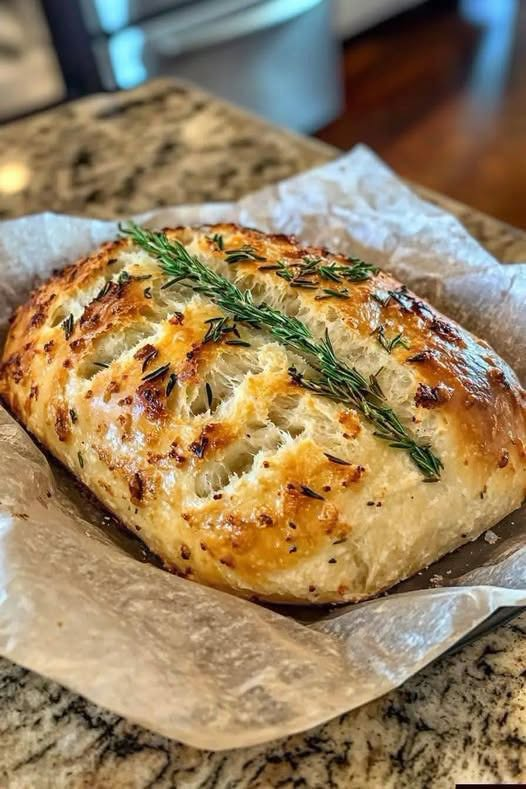
A beautiful homemade rustic bread with a golden, crispy crust, soft and fluffy interior, fresh rosemary, aromatic garlic, and olive oil. This recipe recreates the style of bread shown in your photograph.
1. Recipe Information
Preparation time: 20–25 minutes
First rising time: 1–1½ hours
Second rising time: 30–45 minutes
Baking time: 30–40 minutes
Total time: Approximately 3–4 hours
Yield: 1 large loaf (8–10 servings)
Difficulty: Medium
Oven temperature: 200–220°C
2. Ingredients
For the bread dough:
3 cups (375 g) all-purpose flour or bread flour
1 cup (240 ml) lukewarm water
2 teaspoons instant yeast (7 g)
1 tablespoon sugar or honey
1 teaspoon salt
2 tablespoons olive oil
For the garlic rosemary topping:
3 tablespoons extra virgin olive oil
4 garlic cloves, finely minced
2 tablespoons fresh rosemary, finely chopped
1 teaspoon dried thyme
½ teaspoon dried oregano
½ teaspoon black pepper
½ teaspoon sea salt
1 tablespoon melted butter (optional)
For the golden finish:
1 egg, beaten (optional)
1 tablespoon milk (optional)
1 fresh rosemary sprig
Extra virgin olive oil for brushing
A pinch of flaky sea salt
3. Detailed Preparation Method
Step 1: Activate the yeast
Pour lukewarm water into a mixing bowl.
Add sugar and yeast.
Stir gently.
Leave for 5–10 minutes until foamy if using active dry yeast.
If using instant yeast, mix it directly with the flour.
Step 2: Prepare the dough
Add flour and salt to a large mixing bowl.
Add the yeast mixture.
Pour in olive oil.
Mix until a soft dough forms.
Knead for 8–10 minutes until smooth and elastic.
The dough should be soft and slightly tacky.
Step 3: First proofing
Lightly grease a bowl with olive oil.
Place the dough inside.
Cover with a clean kitchen towel.
Leave in a warm place for 1–1½ hours.
The dough should approximately double in size.
Step 4: Prepare the garlic rosemary topping
In a small bowl, combine:
Olive oil
Minced garlic
Chopped rosemary
Thyme
Oregano
Black pepper
Mix thoroughly and reserve some rosemary for decoration.
Step 5: Shape the loaf
Transfer the risen dough to a lightly floured surface.
Gently press out excess air.
Shape into an oval loaf.
Place on a parchment-lined baking tray.
Brush the surface with the garlic and herb mixture.
Step 6: Second proofing
Cover the loaf and allow it to rise for another 30–45 minutes until slightly puffy.
Step 7: Decorate the bread
Brush with beaten egg mixed with milk for a shiny golden finish.
Make 3–4 shallow diagonal cuts across the top.
Place a fresh rosemary sprig along the center.
Sprinkle with flaky sea salt.
Drizzle lightly with olive oil.
Step 8: Bake
Preheat the oven to 220°C.
Bake for 15 minutes.
Reduce the temperature to 200°C.
Continue baking for another 15–25 minutes.
The bread should have a deep golden-brown crust. Its internal temperature should reach approximately 93–96°C.
Allow it to cool for at least 30 minutes before slicing.
4. Nutritional Information
Approximate values per slice, assuming 10 slices:
Nutrient
Amount
Calories
190–220 kcal
Carbohydrates
32–36 g
Protein
5–6 g
Total fat
4–6 g
Saturated fat
0.5–1.5 g
Fiber
1–2 g
Sugar
1–2 g
Sodium
250–350 mg
Actual values depend on the flour, oil, toppings and slice size.
5. Nut Information and Allergens
Is this recipe nut-free?
Yes. The ingredients listed do not include peanuts or tree nuts.
Ingredient
Allergen information
Wheat flour
Contains gluten
Olive oil
No nut ingredients
Garlic
No major regulated allergen
Rosemary
No major regulated allergen
Yeast
Generally not a major allergen
Egg wash
Contains egg
Butter
Contains milk
For a nut-free version:
Avoid almond flour and nut-based toppings.
Check all packaged ingredients for nut cross-contact warnings.
Use olive oil instead of butter.
Omit egg wash if you also need an egg-free recipe.
Use verified nut-free ingredients and clean equipment if preparing for someone with a serious nut allergy.
6. Professional Baking Tips
Use bread flour for a chewier, more developed texture.
Avoid adding excessive flour while kneading.
Use fresh rosemary for the best aroma.
Do not use too much raw garlic on the crust because it can burn.
Brush the bread with olive oil before baking for a beautiful finish.
Place a heatproof tray of hot water in the oven for extra crust crispness.
Let the bread cool before cutting to preserve its soft interior.
7. Frequently Asked Questions (Q&A)
Q1. Can I make this bread without yeast?
Yes, but the texture will be different. Baking powder can be used for a quick-bread variation.
Q2. Can I use whole wheat flour?
Yes. Replace 30–40% of the white flour with whole wheat flour. You may need slightly more water.
Q3. Can I make this recipe without eggs?
Yes. Brush with olive oil instead of egg wash.
Q4. Can I use dried rosemary?
Yes. Use approximately one-third of the amount of fresh rosemary.
Q5. Why is my bread dense?
Common reasons include inactive yeast, insufficient proofing, too much flour or inadequate kneading.
Q6. Can I prepare the dough overnight?
Yes. Refrigerate the covered dough for 8–18 hours, then allow it to warm slightly before shaping and proofing.
Q7. How should I store the bread?
Room temperature: 2–3 days in an airtight bag.
Freezer: 2–3 months when properly wrapped.
Avoid refrigeration because it can make bread stale faster.
Q8. What can I serve with this bread?
Creamy mushroom soup
Tomato basil soup
Garlic butter
Olive oil and balsamic vinegar
Hummus
Pasta
Roasted vegetables
Cheese dips
Q9. Is this bread vegetarian?
Yes, provided the ingredients used are vegetarian-friendly.
Q10. How do I get a crispy crust and soft center?
Bake at a high initial temperature, introduce some steam into the oven, and avoid overbaking.